

Sadaqah Jariyah is a form of ongoing charity in Islam that keeps benefiting people over time, so the giver keeps earning reward for as long as the benefit continues. The word Jariyah means flowing or continuous, which is why Sadaqah Jariyah is often called ceaseless or ever-flowing charity. A one-time gift of food feeds a person once. A water well, by contrast, serves a whole community for years, and every sip drawn from it is written as a reward for the person who built it.
This is what sets Sadaqah Jariyah apart from ordinary charity. Regular Sadaqah brings immediate relief and immediate reward. Sadaqah Jariyah brings a reward that continues long after the gift is given, and even after the giver has passed away. For this reason, many Muslims treat it as a way to build a lasting legacy of good, giving it in their own name or on behalf of parents and loved ones.
What Does Sadaqah Jariyah Mean?
Sadaqah Jariyah is made of two Arabic words. Sadaqah means voluntary charity given for the sake of Allah. Jariyah means flowing, running, or continuous. Put together, they describe a charity whose benefits keep flowing to people over the long term.
The English synonyms make the idea clear. Sadaqah Jariyah is also called ongoing charity, continuous charity, recurring charity, perpetual charity, and ever-flowing charity. What makes a gift qualify is not its size. It is the durability of the benefit. A small act can become Sadaqah Jariyah when it keeps helping others in a real and lasting way.
The Hadith Behind Sadaqah Jariyah
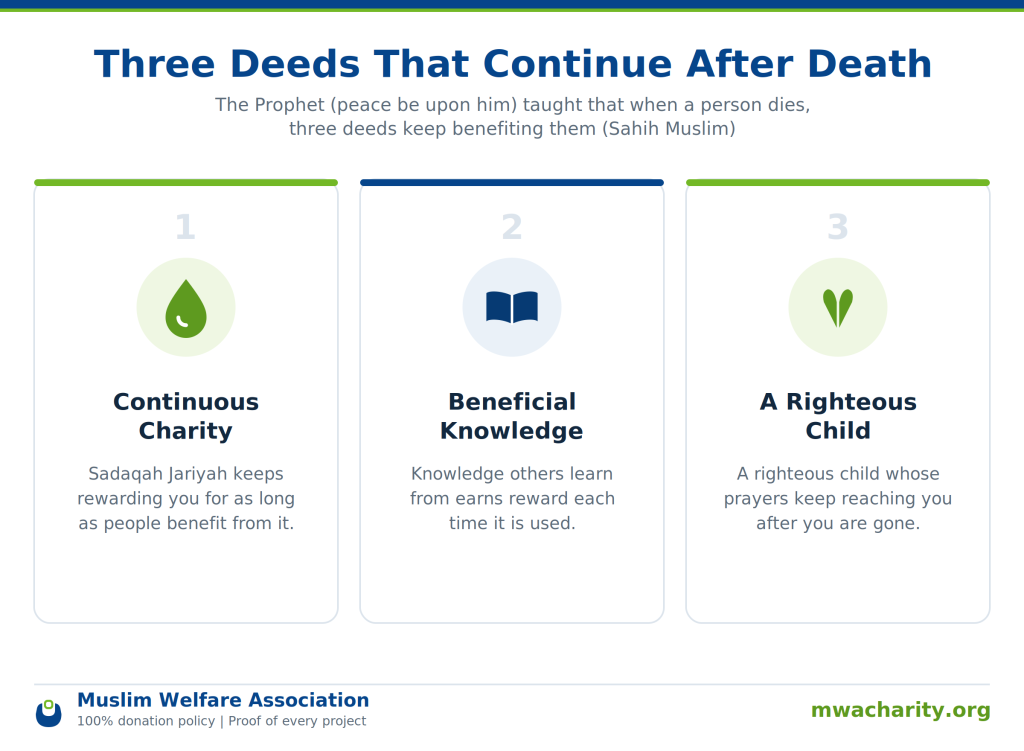
The foundation of Sadaqah Jariyah comes from a well-known saying of the Prophet Muhammad (peace be upon him), narrated by Abu Hurairah in Sahih Muslim. He taught that when a person dies, their deeds come to an end except for three. These are a continuous charity, beneficial knowledge that others gain from, and a righteous child who prays for them.
This narration explains why Sadaqah Jariyah holds such a special place. Most deeds stop the moment a person passes away. These three keep adding to their record, by Allah’s permission, because their impact keeps living in the world. Setting up a continuous charity is therefore a way to keep earning good after death.
The term Sadaqah Jariyah is not named directly in the Quran, yet its spirit runs throughout. The Quran compares charity given for Allah’s sake to a single grain that grows into seven ears, each bearing a hundred grains (Quran 2:261). A well or a school works in the same way. One act multiplies into a benefit that reaches far more people than the original gift.
Sadaqah Jariyah and the Idea of Waqf
In Islamic law, most forms of Sadaqah Jariyah fall under the category of waqf, which means an endowment. With ordinary charity, the item you give becomes the property of the person who receives it. They can use it or dispose of it as they wish.
With a waqf, the asset itself is held in trust and is not given away. Instead, its benefits keep being shared with those in need. A well stays a well. A school stays a school. As long as the endowment remains and people benefit from it, the reward keeps returning to the founder. This is the mechanism that makes Sadaqah Jariyah continuous rather than one-time.
Examples of Sadaqah Jariyah
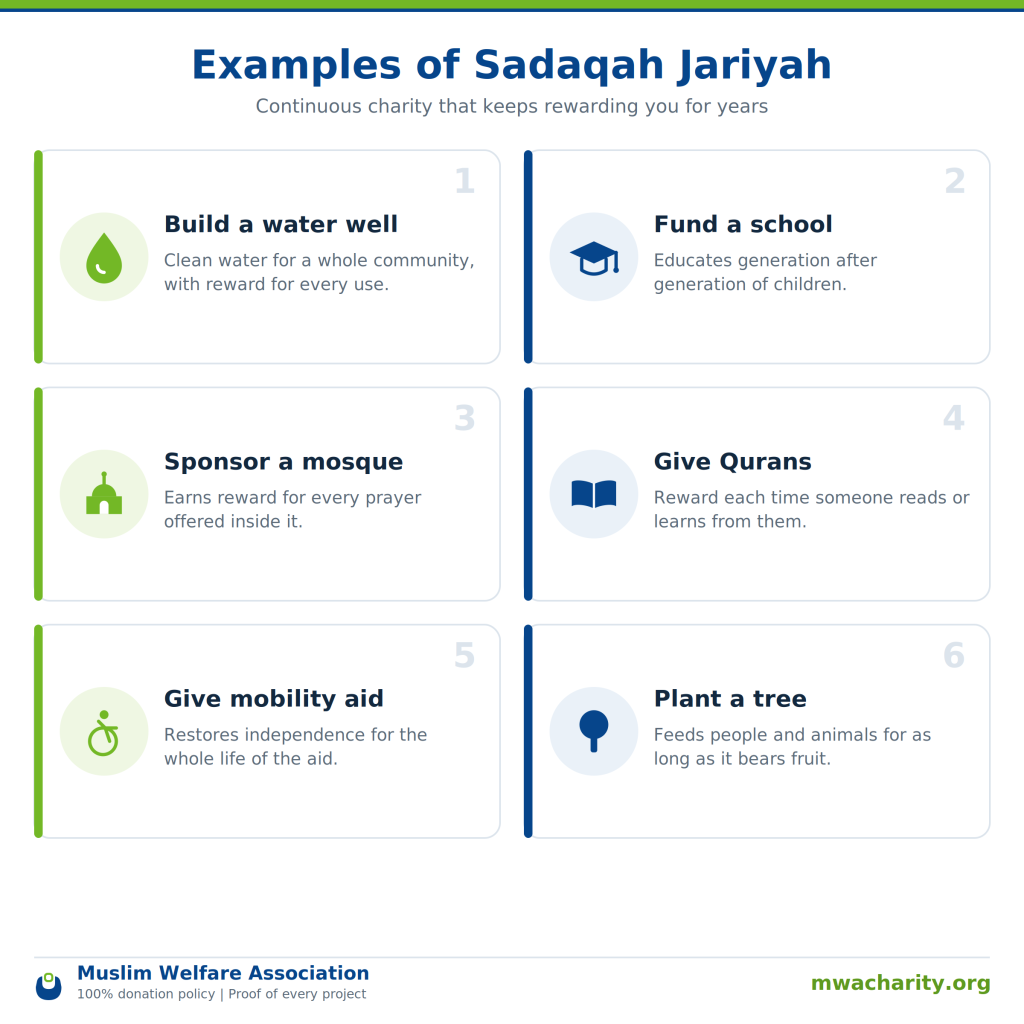
The best way to understand Sadaqah Jariyah is through examples. Each one below keeps producing benefits long after the gift is made.
| Example | Why does it keep giving |
|---|---|
| Building a water well | Serves clean water to a community for years, with a reward for every use |
| Funding a school or madrasa | Educates generation after generation of children |
| Building or sponsoring a mosque | Rewards the founder for every prayer offered inside it |
| Sponsoring Qurans or Islamic books | Earns a reward each time someone reads or learns from them |
| Giving a wheelchair or mobility aid | Restores independence to a person for the life of the aid |
| Planting a tree or crop | Feeds people, birds, and animals for as long as it bears fruit |
| Supporting an orphan’s care and education | Builds a righteous, self-reliant adult who benefits others |
A saying of the Prophet (peace be upon him) confirms the reach of these acts. When a Muslim plants something and a person, bird, or animal eats from it, it is counted as charity for them (Bukhari and Muslim).
Sadaqah Jariyah: You Can Start Today
Sadaqah Jariyah is not limited to large projects. Several forms are within reach of almost anyone.
- Share beneficial knowledge. Teach someone to pray, help a child memorise an ayah, or pass on a useful skill. Every person who acts on it brings you a reward.
- Support a lasting project. Contribute toward a well, a classroom, or a mosque, even as part of a group. A share in the project earns a share in the reward.
- Raise a righteous child. Guiding a child toward good is itself Sadaqah Jariyah, since their prayers and good deeds continue to benefit you.
- Give in the name of a loved one. Sadaqah Jariyah can be dedicated to parents or others who have passed, and the reward reaches them.
The Rewards and Benefits of Sadaqah Jariyah
The rewards of Sadaqah Jariyah reach into the afterlife, which is what makes it so valued.
- Reward that continues after death. It is one of only three deeds the Prophet (peace be upon him) said keeps benefiting a person once they die.
- Multiplied blessings. Like the grain that yields seven hundred, a single project can reward you many times over.
- A living legacy. Your good remains in the world in the form of water, shelter, learning, and care.
- Comfort in grief. Giving in the name of a lost loved one brings blessings to them and peace to those left behind.
- Ongoing purification. Continuous giving keeps the heart detached from wealth and connected to Allah.
Give Sadaqah Jariyah With Muslim Welfare Association
Muslim Welfare Association (MWA) is a registered 501(c)3 nonprofit that has served vulnerable communities since 2012. MWA runs Sadaqah Jariyah projects that keep giving for years, including clean water wells, schools, mosques, Qurans, and mobility aid across Africa, India, and Pakistan.
Every donation carries a 100% policy, so the full amount reaches the cause you choose. MWA also shares photo and video proof of completed projects, so you can see your Sadaqah Jariyah take shape. To begin, visit mwacharity.org, build a lasting Sadaqah Jariyah water well, sponsor Qurans for mosques, or give mobility for $350.
Frequently Asked Questions
What is Sadaqah Jariyah in simple terms?
It is an ongoing charity that keeps benefiting people over time, so the giver keeps earning a reward for as long as the benefit lasts, even after death.
Is Sadaqah Jariyah mentioned in the Quran?
The exact term is not named in the Quran, but its meaning is present throughout, including the verse that likens charity to a grain yielding many times over (Quran 2:261). The clearest teaching is the hadith in Sahih Muslim about the three deeds that continue after death.
What is the difference between Sadaqah and Sadaqah Jariyah?
Sadaqah is any voluntary charity and often gives an immediate, one-time benefit. Sadaqah Jariyah is the ongoing type, such as a well or a school, that keeps benefiting people for years.
Can I give Sadaqah Jariyah for someone who has died?
Yes. It can be given on behalf of parents or loved ones who have passed, and the reward reaches them.
What are the best examples of Sadaqah Jariyah?
Building water wells, funding schools and mosques, sponsoring Qurans, giving mobility aid, planting trees, and sharing beneficial knowledge are among the most common and rewarding examples.