

Sadaqah is voluntary charity given for the sake of Allah, with no fixed amount, no set time, and no obligation attached. The word carries the meaning of sincerity and righteousness, and in practice, it covers far more than money. A kind word, a shared meal, or a helping hand all count as Sadaqah when the intention is to please Allah. This is what separates Sadaqah from other forms of giving in Islam. It flows from genuine care rather than duty.
Because it is voluntary, Sadaqah can be given by anyone to anyone in need, in any amount, at any time of year. There is no minimum. A single date given in charity is recorded, and so is a smile offered to a stranger. The value of the act rests on sincerity, not size. This makes Sadaqah one of the most accessible acts of worship in Islam, open to the wealthy and the poor alike.
What Does the Word Sadaqah Mean?
The word Sadaqah comes from the Arabic root sidq, which means sincerity, truthfulness, and keeping one’s word. That root shapes the whole idea. Giving Sadaqah is treated as proof of honest faith because a person who parts with something they value for Allah’s sake shows the truth of what they believe.
The term and its plural, sadaqat, appear multiple times in the Quran. In everyday use, Sadaqah refers to any good deed done to benefit another creature without expecting a return. That definition stretches from financial donations to acts of service and even simple courtesy.
Sadaqah vs Zakat vs Sadaqah Jariyah
These three terms are often confused. They are connected but distinct. The table below sets out the difference clearly.
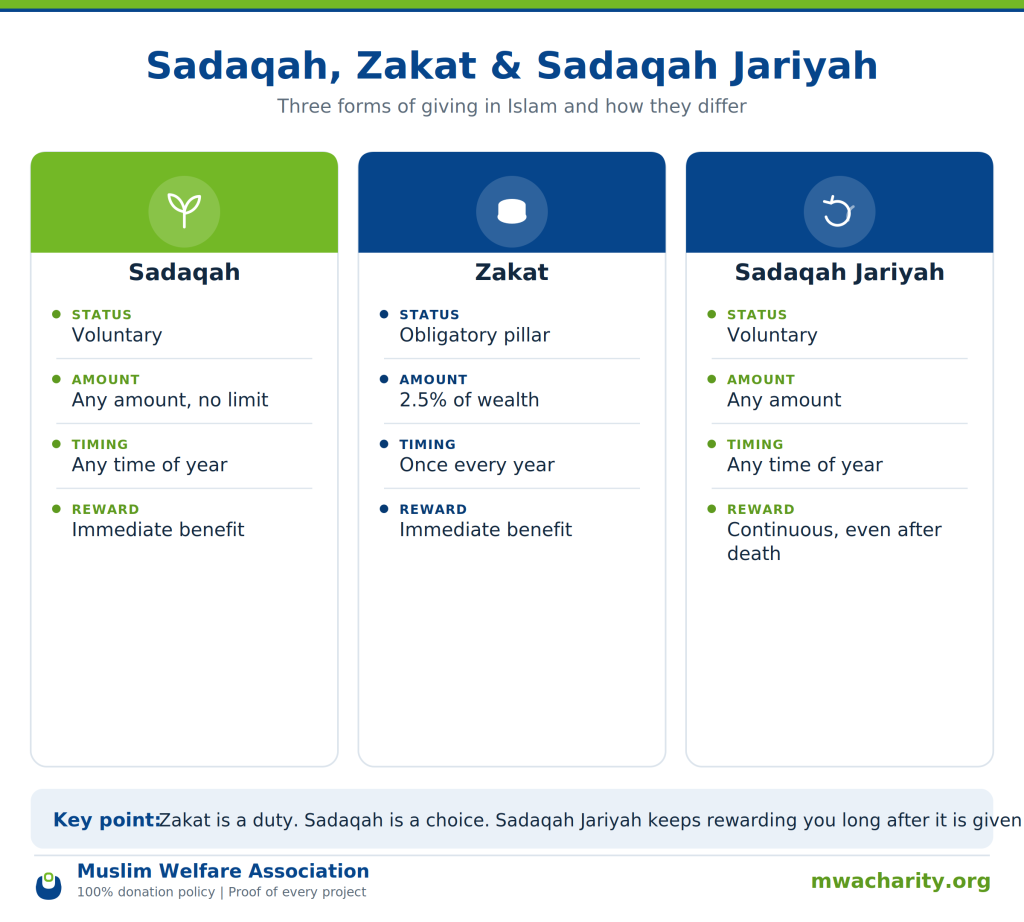
| Feature | Sadaqah | Zakat | Sadaqah Jariyah |
|---|---|---|---|
| Status | Voluntary | Obligatory | Voluntary |
| Amount | Any amount, no limit | Fixed at 2.5% of qualifying wealth | Any amount |
| Timing | Any time of year | Once yearly, when the threshold is met | Any time |
| Form | Money, goods, services, and kind acts | Wealth only | Lasting projects that keep benefiting people |
| Who can give | Anyone | Muslims who meet the wealth threshold | Anyone |
| Can it be given on behalf of others | Yes | No | Yes |
| Reward duration | Immediate | Immediate | Continuous, even after death |
Zakat is one of the five pillars of Islam and follows strict rules on who must pay, how much, and where it can go. Sadaqah has none of those conditions. Sadaqah Jariyah is a special category of Sadaqah. It refers to an ongoing charity that keeps producing rewards long after the gift is given, such as a water well, a school, or a fruit tree that feeds people for years.
Types of Sadaqah
Sadaqah is not limited to donations. It falls into three broad types.
- Financial Sadaqah. Giving money, food, clothing, or other goods to people in need. Sponsoring a meal or covering a family’s essentials both belong here.
- Non-financial Sadaqah. Acts of kindness and service that cost no money. Volunteering time, offering a sincere smile, removing harm from a path, or helping someone carry a load.
- Sadaqah Jariyah. Continuous charity that outlives the giver. Building a water well, funding a mosque or school, sponsoring Qurans, or giving mobility to a disabled child. At Muslim Welfare Association (MWA), each of these is an active Sadaqah Jariyah project that keeps earning reward for the donor as long as people benefit.
Each type earns a reward. The everyday, non-financial acts often go unnoticed, yet the Prophet Muhammad (peace be upon him) taught that even the smallest kindness is charity.
Sadaqah in the Quran and Hadith
The importance of Sadaqah is grounded in clear sources. Two references stand out.
The Quran compares charity given for Allah’s sake to a seed that grows seven ears, each carrying a hundred grains, and states that Allah multiplies the reward for whoever He wills (Quran 2:261). This image explains why a small gift is never small in outcome.
The Quran also links giving to righteousness, teaching that a person will not attain true piety until they spend from what they love (Quran 3:92). Giving something you value, rather than something you no longer want, is what raises the act.
Several sayings of the Prophet Muhammad (peace be upon him) reinforce this. He taught that “Sadaqah extinguishes sins as water extinguishes fire” (Tirmidhi). He also described charity as the believer’s shade on the Day of Resurrection (Tirmidhi). These narrations tie Sadaqah directly to forgiveness and protection.
The Rewards of Giving Sadaqah
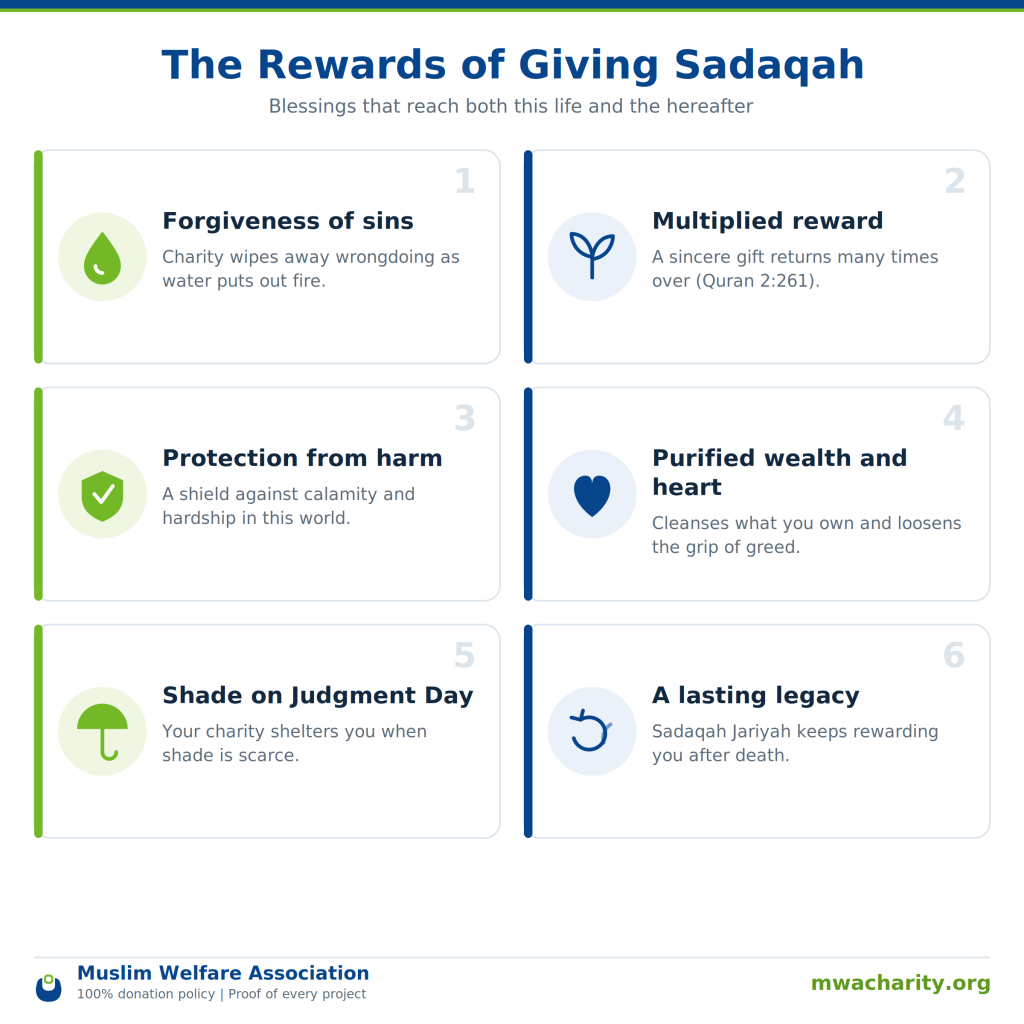
The rewards of Sadaqah reach both this life and the next. They are spiritual before they are material.
- Forgiveness of sins. Charity is described as wiping out wrongdoing the way water puts out fire.
- Multiplied return. A sincere gift is recorded as far greater than its worth, following the seed that yields many times over.
- Protection from harm. Giving is understood to shield a person from calamity and hardship in this world.
- Purification of wealth and soul. Sadaqah cleanses what a person owns and loosens the grip of greed on the heart.
- Shade on the Day of Judgment. The believer’s charity is said to shelter them on a day when shade is scarce.
- A lasting legacy. Through Sadaqah Jariyah, reward keeps reaching the giver long after they have passed.
There is a quieter benefit too. Regular giving reminds a person that their wealth is a trust from Allah rather than a permanent possession. That shift in outlook brings a calm that money alone cannot buy.
Everyday Acts That Count as Sadaqah
One of the most striking teachings about Sadaqah is how ordinary it can be. The Prophet Muhammad (peace be upon him) counted many simple actions as charity.
- Smiling at someone
- Speaking a kind or truthful word
- Removing a stone, thorn, or hazard from the road
- Helping a person onto their ride or lifting their belongings
- Guiding someone who is lost
- Giving water to a person, an animal, or a plant
A narration records that when a Muslim plants something and a person, bird, or animal eats from it, that too is written as charity (Bukhari and Muslim). This means acts of goodness are within reach even for someone with no money to give.
Who Can Give and Who Can Receive Sadaqah
Anyone can give Sadaqah. There is no wealth requirement and no age limit. A person can also give it on behalf of someone else, including a relative who has passed away, and the deceased benefits from it.
Sadaqah can be received by anyone in genuine need. This includes a neighbour struggling to cope, a traveller who is stranded, an orphan, or a stranger going through hardship. Family members can also receive it. Giving to a relative in need carries the reward of both charity and maintaining family ties.
How to Give Sadaqah
Giving Sadaqah starts with intention. The aim is to please Allah, not to be seen. From there, the act can take many shapes.
- Set aside a small regular amount rather than waiting for a large one.
- Choose causes that create lasting benefit if you want the reward of Sadaqah Jariyah.
- Look for non-financial ways to give on days when money is tight.
- Keep giving privately where possible, since discreet charity is praised in Islam.
The habit matters more than the amount. Frequent, sincere giving builds a steady connection with Allah and a steady concern for others.
Give Your Sadaqah With Muslim Welfare Association
Muslim Welfare Association (MWA) is a registered 501(c)3 nonprofit that has served vulnerable communities since 2012. Your Sadaqah and Sadaqah Jariyah reach families across Africa, India, and Pakistan through clean water wells, schools, mosques, Qurans, wheelchairs, and food and clothing aid.
Every donation carries a 100% policy, which means the full amount goes to the cause you choose. MWA also shares photo and video proof of completed projects, so you can see the reward of your Sadaqah taking shape. Fund a lasting Sadaqah Jariyah water well, or give mobility to a child.
Frequently Asked Questions
Is Sadaqah the same as Zakat?
No. Zakat is obligatory, fixed at 2.5% of qualifying wealth, and paid once a year. Sadaqah is voluntary, has no set amount, and can be given at any time.
Can a non-Muslim receive Sadaqah?
Yes. Sadaqah can be given to anyone in need, regardless of faith.
Can I give Sadaqah on behalf of someone who has died?
Yes. Sadaqah given on behalf of the deceased reaches them and brings them reward.
Does a small donation still count?
Yes. Even a single date or a kind word is recorded. Sincerity is what gives the act its weight.
What is the difference between Sadaqah and Sadaqah Jariyah?
Sadaqah brings immediate benefits, such as giving food. Sadaqah Jariyah keeps benefiting people over time, such as by building a well, so the reward continues for years.
Where can I give Sadaqah online?
You can give Sadaqah, Zakat, and Sadaqah Jariyah through the Muslim Welfare Association. MWA, which delivers 100% of your donation to the cause and sends proof of every completed project.