

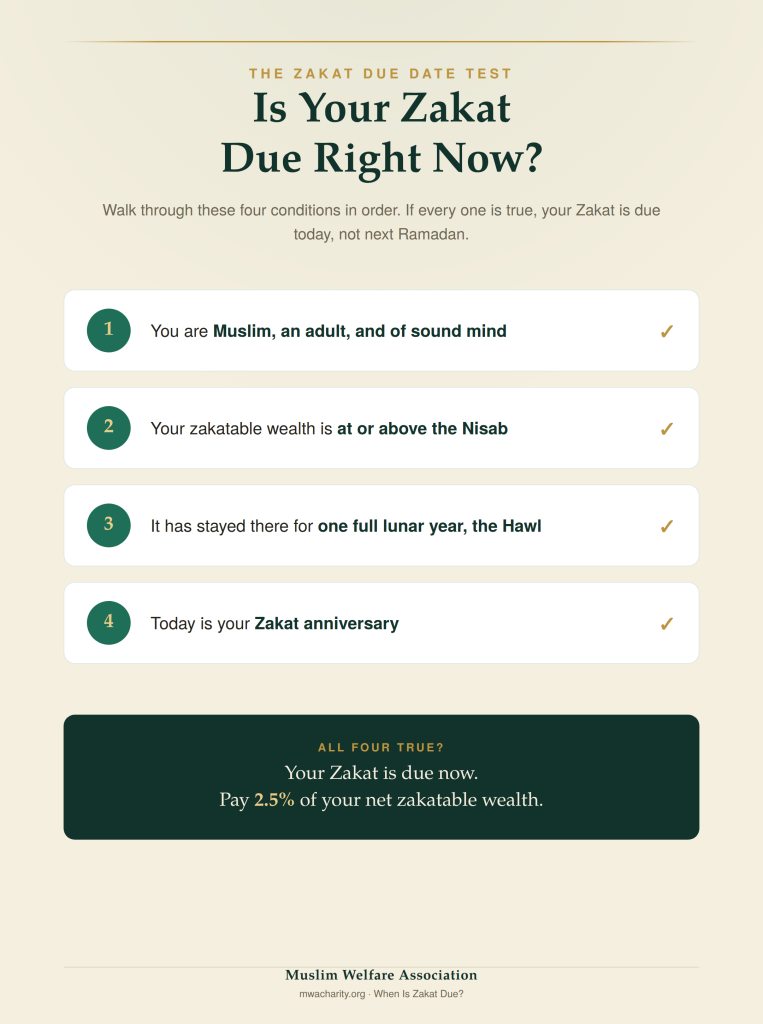
Zakat is due once your qualifying wealth has stayed at or above the Nisab threshold for one complete Islamic lunar year. This one year is called the Hawl. That due date is not fixed to Ramadan or to any date on the Gregorian calendar. It is personal to you, set by the day your own wealth first reached the Nisab. Once that day comes around each year, Zakat stops being a future duty and becomes an active one. Putting it off without a genuine reason is not permitted. Knowing your Zakat year protects your worship. It also makes sure the people who depend on Zakat are not kept waiting for it.
This guide walks through how the Zakat year actually works. It covers the day your Hawl starts, the day it becomes due, and what happens if your wealth rises, falls, or arrives partway through the year. Zakat is the third pillar of Islam and a right owed to the poor. Getting the timing correct is not a small detail. It is part of the obligation itself. Once you know your date, the Muslim Welfare Association (MWA) can help you complete it. We deliver your Zakat to eligible families across Africa, Bangladesh, India, and Pakistan, with photo and video proof of every project.
What Makes Zakat Due? Nisab and Hawl Together
Zakat becomes due only when two conditions are met at the same time. Your wealth must reach the Nisab, and it must stay there for one full lunar year. Neither condition is enough on its own.
- Nisab is the minimum amount of wealth that makes you liable for Zakat. The Prophet ﷺ fixed it at the value of 87.48 grams of gold or 612.36 grams of silver. Ali ibn Abi Talib (may Allah be pleased with him) reported that nothing is owed on gold until it reaches twenty dinars, and that a full year must pass before it is due, as related in Sunan Abu Dawud, a ruling scholars across the major schools have relied on for centuries.
- Hawl is the one lunar year that must pass while your wealth remains at or above that threshold. Aisha (may Allah be pleased with her) reported that the Messenger of Allah ﷺ said, “There is no Zakat on wealth until a year has passed over it” (Sunan Ibn Majah 1792, graded Sahih).
These two conditions explain why two Muslims with the same bank balance can have completely different Zakat due dates. Nisab tells you whether you owe Zakat at all. Hawl tells you when.
When Does Your Zakat Year (Hawl) Begin?
Your Zakat year begins on the day your zakatable wealth first equals or exceeds the Nisab. Many Muslims call this their Zakat anniversary. From that day, count 354 days, roughly one Hijri year, and you arrive at your due date. That date then repeats every year on the same Hijri date for as long as your wealth stays eligible.
If this is your first year paying Zakat, choose the day your savings first reached the Nisab as your start date. If you cannot remember the exact day, a careful estimate is enough. Many Muslims round to the nearest Islamic month, or pick a memorable date such as the start of a new Hijri year, and then stay consistent with it every year after. What matters most is choosing one date and keeping it, rather than recalculating a new start date whenever it feels convenient.
Does Every Type of Wealth Follow the Same Timeline?
No. Zakat runs on two separate timelines depending on the kind of wealth involved.
| Wealth type | Examples | When Zakat is due |
|---|---|---|
| Growth wealth | Cash, gold, silver, business stock, shares | After one full lunar year (Hawl) above the Nisab |
| Land and mineral wealth | Crops, fruit, honey, mined resources | Immediately at harvest or extraction |
Allah says in the Quran, describing fruits and crops: “Eat of its fruit when it yields, and give its due on the day of harvest.” Surah Al-An’am (6:141), Sahih International. Scholars have long read this verse as the basis for paying Zakat on produce the moment it is gathered, with no year-long wait attached.
The reasoning behind the split is simple. Cash and trade goods take time to grow in value, so a full year gives that growth room to be measured fairly. A harvest is already a complete increase the moment it is picked, so there is no reason to make the poor wait a year for something that has already ripened. If your zakatable wealth is a mix of both, such as savings alongside farmland, each portion is worked out on its own timeline.
What Happens If Your Wealth Drops Below Nisab During the Year?
The answer depends on which school of Islamic law you follow, and the difference is worth knowing before it affects your own count.
| School of thought | If wealth dips below Nisab mid-year |
|---|---|
| Hanafi | Only the start and end of the Hawl matter. A temporary dip does not break the count, as long as you hold the Nisab at the start of the year and again on the due date. |
| Maliki, Shafi’i, and Hanbali | A dip below Nisab at any point resets the Hawl. The year begins counting again from the day your wealth rises back above the Nisab. |
If you are unsure which position applies to you, a short conversation with a knowledgeable local imam or scholar will settle it. In practice, this question mostly affects people with irregular income or a business with seasonal cash flow, since most personal savings do not swing below the Nisab and back up within a single year.
What About New Money That Arrives Partway Through the Year?
A salary deposit, a gift, a bonus, or an inheritance rarely lands exactly on your Zakat anniversary, so it helps to know how new wealth fits into your existing count.
Most scholars, including the Hanafi and Hanbali schools, have a simple answer for wealth of the same kind. They add the new amount to your existing total. It is then counted under your original Hawl. In practice, a salaried worker does not track a separate one-year countdown for every paycheck. Each deposit simply joins the pool that comes due on the existing Zakat anniversary. The Shafi’i school takes a more careful view and gives each deposit its own year. Still, most donors find the majority position easier to apply, and it is no less valid.
New wealth of a different kind is treated differently. Say your existing wealth is business stock, and you then inherit gold. That gold is usually in its own case. Its own Hawl starts from the day you received it.
Either way, if you did not yet hold the Nisab and a lump sum, such as an inheritance, brings you above it for the first time, that day becomes your new Zakat anniversary going forward.
Can You Pay Zakat Before Its Due Date?
Yes. Paying Zakat ahead of your due date is permitted and does not affect its validity, as long as you already hold the Nisab. Ali (may Allah be pleased with him) reported that Al-Abbas, the Prophet’s uncle, asked the Messenger of Allah ﷺ about paying his charity before it was due, and he permitted him to do so (Jami’ at-Tirmidhi 678, graded Hasan). This is one reason so many Muslims choose to give during Ramadan even when their actual Hawl completes in a different month.
If you pay early, treat the amount as an estimate rather than a final figure. When your real due date arrives, recalculate based on what you actually own that day. If you paid too little, make up the difference. If you paid more than required, the surplus simply counts as Sadaqah, a voluntary gift that carries its own reward.
What Happens If You Miss or Delay Your Zakat Due Date?
Zakat does not expire and does not disappear if it is missed. The obligation stays on you until it is paid, and delaying it without a genuine reason is sinful, since the poor hold a right in that wealth from the moment your Hawl completes. Allah instructed the Prophet ﷺ to “take from their wealth a charity by which you purify them and cause them to increase.” Surah At-Tawbah (9:103), Sahih International. Purification that is delayed without cause is purification withheld, so scholars treat prompt payment as part of honoring what Zakat is meant to do, not only a date to meet.
You might have missed one or more years of Zakat. Perhaps you forgot, or you were confused about your due date, or you did not realize you were obligated. The response is the same every time. Work out as accurately as you can what you owed for each missed year. Pay it as soon as you are able. There is no need to wait until you can settle every missed year at once. Pay what you can now, and commit to the rest. That is far better than letting discouragement stop you from paying anything at all.
Is Ramadan Your Zakat Due Date?
Not necessarily. Ramadan is a beloved month for giving because good deeds carry greater reward within it, but your Zakat due date is tied to your personal Hawl, not to any month on the calendar. If your Hawl happens to complete during Ramadan, that works out well. If it completes in Rajab, Dhul Hijjah, or any other month, that is your real due date, and it should not be pushed back just to wait for Ramadan to arrive.
Many Muslims solve this by paying early every year, so their giving lines up with Ramadan regardless of when their actual Hawl falls. This is fully permitted, as long as the amount is checked again once the real due date arrives.
How to Find and Track Your Own Zakat Due Date
Work out your Zakat date in three steps.
- Identify your seed date. This is the day your total zakatable wealth first reached the Nisab. If you are unsure, estimate as closely as you reasonably can.
- Convert it to the Hijri calendar. Use a Hijri date converter if you only know the Gregorian date. Your Zakat date follows the Islamic calendar, which is about eleven days shorter than the Gregorian year.
- Mark the same Hijri date every year. This becomes your personal Zakat anniversary. Set a reminder a few weeks ahead of time, so you have room to calculate carefully instead of rushing on the day itself.
Here is how it plays out for one donor. Amira’s savings first passed the Nisab on 10 Ramadan 1447. Her Zakat year runs for 354 days from that date, so her Zakat became due on 10 Ramadan 1448, whatever her wealth did in between, provided she met the condition of her school of thought as explained above. Every year afterward, 10 Ramadan is Amira’s fixed Zakat anniversary. On that date, she adds up her zakatable wealth, subtracts what she owes in immediate debts, and pays 2.5 percent of what remains, following the same steps used to calculate Zakat.
Current Nisab Values to Check If Zakat Is Due
Before you confirm that your Zakat is due, check today’s Nisab, since gold and silver prices move every day.
| Nisab basis | Weight | Approx. value (early July 2026) |
|---|---|---|
| Gold | 87.48 grams | About $11,700 USD |
| Silver | 612.36 grams | About $1,240 USD |
Most scholars recommend using the silver Nisab, since it is the lower figure and allows more Muslims to fulfill the obligation, which means more support reaches the poor. Prices shift often, so confirm the live rate on the day your Hawl completes. For the full method, including which assets count and a worked calculation.
Frequently Asked Questions About When Zakat Is Due
When exactly is Zakat due?
Zakat is due the moment your zakatable wealth has stayed at or above the Nisab for one full Islamic lunar year. This date is personal to you and repeats every year on the same Hijri date, known as your Zakat anniversary.
What is Hawl in Zakat?
Hawl is the Islamic lunar year, about 354 days, that must pass over your qualifying wealth before Zakat becomes due on it. It applies to cash, gold, silver, and business assets, but not to crops or minerals, which are due at harvest instead.
Does my Zakat due date change every year?
No, not usually. Once you know the day your wealth first reached the Nisab, that same Hijri date is your due date every year, as long as your wealth stays eligible. It only shifts if your wealth drops below the Nisab and later returns to it.
Do I have to pay Zakat during Ramadan?
No. Many Muslims choose Ramadan for the extra reward, but your legal due date is tied to your own Hawl. If it falls outside Ramadan, that is when payment is required, and it should not be delayed to wait for Ramadan to begin.
What if I do not know when my wealth first reached the Nisab?
Make a careful and honest estimate of the date, then use that estimate as your fixed Zakat anniversary going forward. It is better to settle on a reasonable date and commit to it than to keep guessing every year.
Can I split my Zakat payment across the year instead of paying it all at once?
Yes. Many scholars allow paying in installments throughout the year, as long as the full amount owed is settled by your due date.
Give Your Zakat with MWA the Moment It Is Due
Once you know your Zakat is due, giving it should feel simple, not stressful. Muslim Welfare Association (MWA) is a registered 501(c)(3) nonprofit that has served vulnerable communities since 2012 (EIN 83-0841269). When you give your Zakat through MWA, you can expect:
- A 100 percent donation policy ensures the full value of your Zakat reaches eligible recipients.
- Photo and video proof of your donation in action, sent directly to you.
- Trusted distribution to families across Africa, Bangladesh, India, and Pakistan who fall within the categories Allah named in the Quran.
Families in these regions are often forced to choose between food, medicine, and shelter. Your Zakat, given the moment it is due, can lift that burden without delay.
Donate your Zakat now and let your wealth become a source of relief and lasting reward. May Allah accept your Zakat, purify your wealth, and reward you abundantly. Ameen.