

Quick answer: Takbir al-Tashriq is: Allahu Akbar, Allahu Akbar, La ilaha illallahu wallahu Akbar, Allahu Akbar wa lillahil hamd. It is recited once, immediately after each fard prayer, from Fajr on 9 Dhul Hijjah to Asr on 13 Dhul Hijjah. That is 23 prayers. Men say it aloud and women say it quietly.
Takbir al-Tashriq is a short declaration of Allah’s greatness that Muslims recite after every obligatory prayer during the days of Eid al-Adha. It begins after Fajr on the Day of Arafah, 9 Dhul Hijjah. It ends after Asr on 13 Dhul Hijjah. That covers 23 fard prayers across five days. In Pakistan and much of South Asia it is known as Takbeer e Tashreeq. In the Hanafi school it is wajib, a necessary act for every adult Muslim who performs the fard prayer.
The wording is brief, but its meaning is profound. In a few phrases the believer affirms tawhid, glorifies Allah and returns all praise to Him. These days are filled with Qurbani, family gatherings and meals. The takbir keeps the heart connected to the One who made the sacrifice possible. This guide covers the exact wording, the timing prayer by prayer, the rulings of the four schools, and the wisdom behind this Sunnah practice.
What Is Takbir al-Tashriq?
Takbir al-Tashriq is the restricted takbir (takbir muqayyad) of Eid al-Adha. It is called “restricted” because it is tied to a specific act, the completion of an obligatory prayer. The unrestricted takbir (takbir mutlaq) is different. It may be said at any time during the first ten days of Dhul Hijjah and the days of Tashriq.
The practice is built on the Quran, the Sunnah and the consistent action of the Companions. Allah says, “And remember Allah during the numbered days” (Al-Baqarah 2:203). Most commentators identify these numbered days as the days of Tashriq. The Prophet ﷺ said, “The days of Tashriq are days of eating, drinking and remembrance of Allah” (Sahih Muslim 1141).
The Meaning of the Word Tashriq
The word comes from the Arabic root sh-r-q, which relates to sunrise and to exposing something to the sun. Before refrigeration, pilgrims at Mina cut the meat of their sacrificial animals into strips and dried it in the sun. This process was called tashriq. The three days after Eid, 11, 12 and 13 Dhul Hijjah, took their name from this practice.
The Hanafi jurists also use the word in a technical sense. For them, tashriq refers to raising the voice in proclaiming the greatness of Allah. Both meanings meet in these days: meat drying in the sun and voices rising with takbir.
The Wording of Takbir al-Tashriq
The wording adopted by the Hanafi and Hanbali schools, and recited in most mosques across Pakistan, is:
Arabic
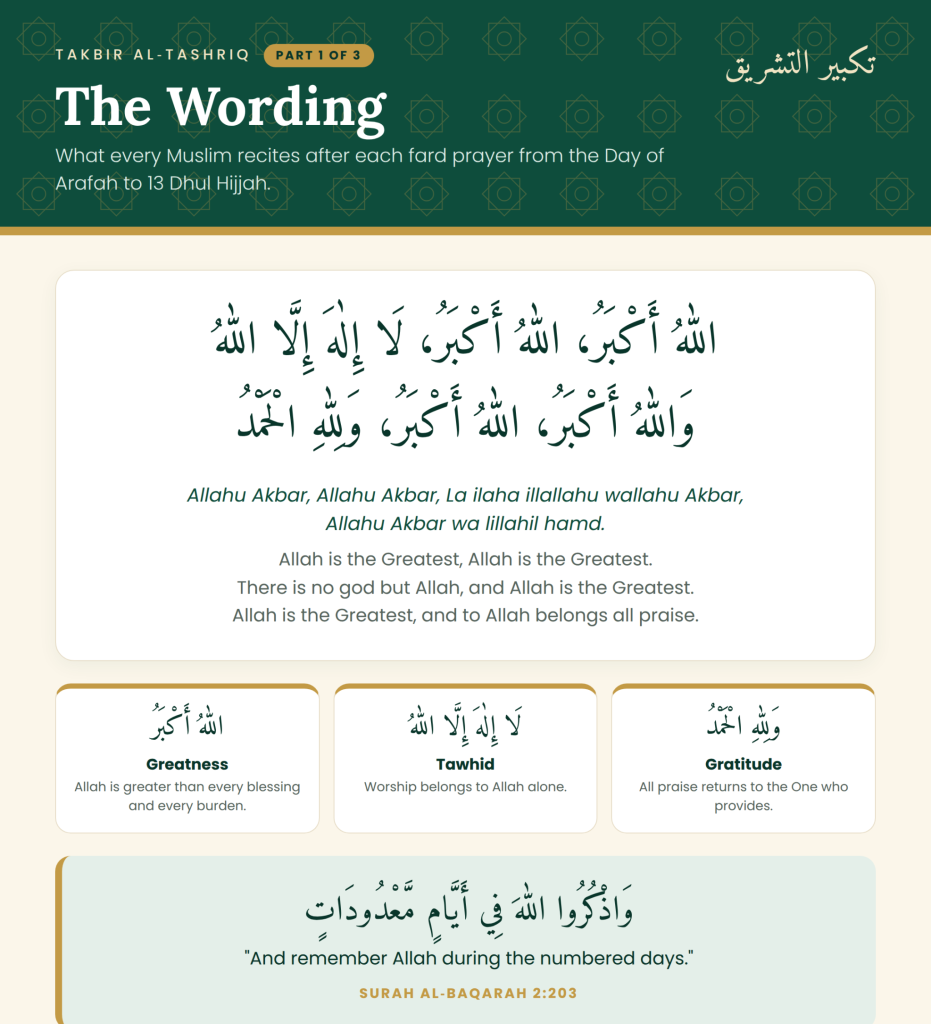
اللهُ أَكْبَرُ، اللهُ أَكْبَرُ، لَا إِلٰهَ إِلَّا اللهُ، وَاللهُ أَكْبَرُ، اللهُ أَكْبَرُ، وَلِلّٰهِ الْحَمْدُ
Transliteration
Allahu Akbar, Allahu Akbar, La ilaha illallahu wallahu Akbar, Allahu Akbar wa lillahil hamd.
Translation
Allah is the Greatest, Allah is the Greatest. There is no god but Allah, and Allah is the Greatest. Allah is the Greatest, and to Allah belongs all praise.
Phrase by Phrase Meaning
| Arabic phrase | Transliteration | Meaning | What it affirms |
|---|---|---|---|
| اللهُ أَكْبَرُ اللهُ أَكْبَرُ | Allahu Akbar, Allahu Akbar | Allah is the Greatest (twice) | Allah is greater than every blessing, burden and desire |
| لَا إِلٰهَ إِلَّا اللهُ | La ilaha illallah | There is no god but Allah | Tawhid, the foundation of Islam |
| وَاللهُ أَكْبَرُ | Wallahu Akbar | And Allah is the Greatest | Worship belongs to the One who is supreme |
| اللهُ أَكْبَرُ | Allahu Akbar | Allah is the Greatest | Renewed glorification |
| وَلِلّٰهِ الْحَمْدُ | Wa lillahil hamd | And to Allah belongs all praise | Gratitude for guidance and provision |
The Three Takbir Variant
The Maliki and Shafi’i schools recommend opening with three takbirs instead of two:
Allahu Akbar, Allahu Akbar, Allahu Akbar, La ilaha illallahu wallahu Akbar, Allahu Akbar wa lillahil hamd.
Both forms are reported from the Companions, and both are valid. A Hanafi should keep to the two takbir form, since that is the relied upon wording of the school.
When to Recite Takbir al-Tashriq
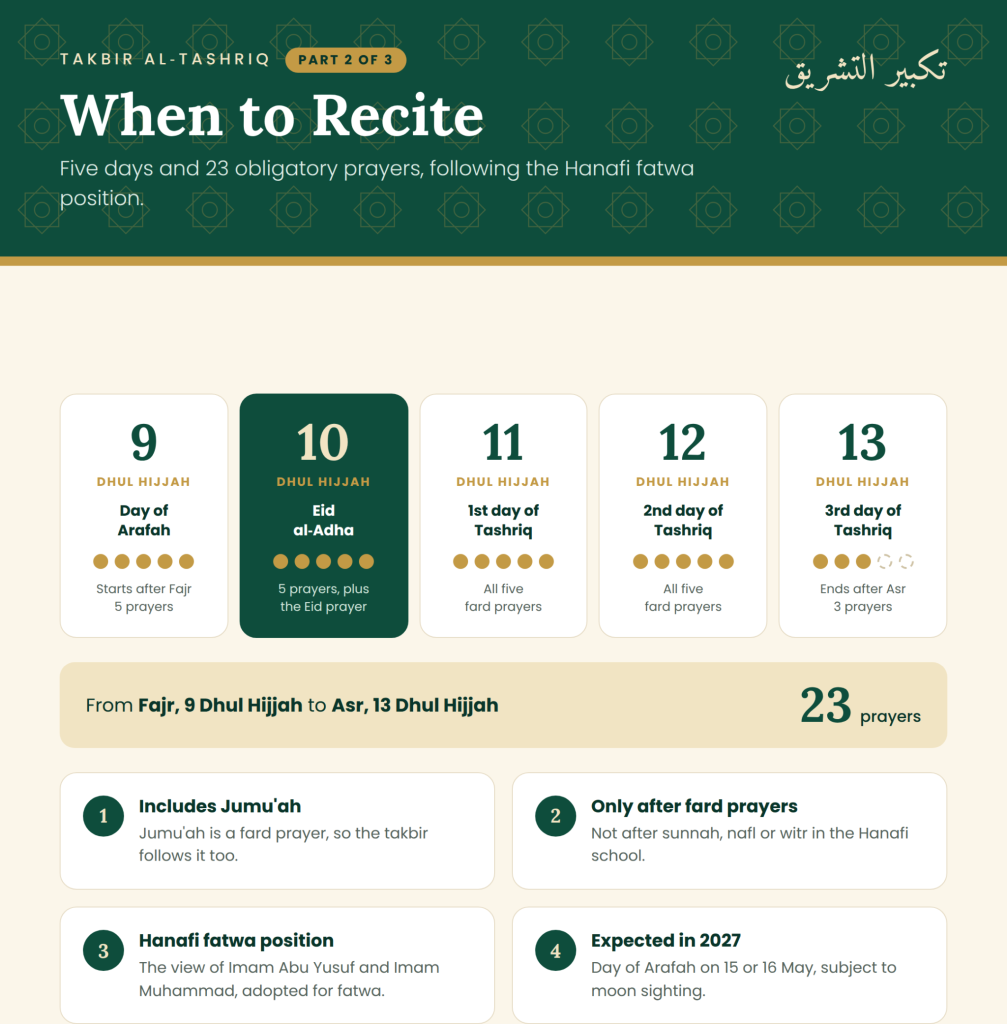
The Hanafi fatwa position is that the takbir begins with Fajr on the Day of Arafah and ends with Asr on 13 Dhul Hijjah. It is recited after Maghrib on the 13th only if you follow a view that extends it. The Hanafi fatwa position does not.
| Hijri date | Day | Prayers with takbir | Count |
|---|---|---|---|
| 9 Dhul Hijjah | Day of Arafah | Fajr, Zuhr, Asr, Maghrib, Isha | 5 |
| 10 Dhul Hijjah | Eid al-Adha (Yawm al-Nahr) | Fajr, Zuhr, Asr, Maghrib, Isha | 5 |
| 11 Dhul Hijjah | First day of Tashriq | Fajr, Zuhr, Asr, Maghrib, Isha | 5 |
| 12 Dhul Hijjah | Second day of Tashriq | Fajr, Zuhr, Asr, Maghrib, Isha | 5 |
| 13 Dhul Hijjah | Third day of Tashriq | Fajr, Zuhr, Asr | 3 |
| Total | 23 |
On Friday within these days, the takbir is recited after Jumu’ah, since Jumu’ah is a fard prayer. It is also recommended after the Eid prayer itself, following the inherited practice of the Muslim community.
Expected Dates for 2027 (1448 AH)
The Hijri dates never change, but the Gregorian dates move about eleven days earlier each year. Astronomical estimates place the Day of Arafah on 15 or 16 May 2027 and Eid al-Adha on 16 or 17 May 2027. On those estimates the takbir would begin at Fajr on 15 or 16 May and end at Asr on 19 or 20 May 2027. Final dates depend on the local moon sighting. In Pakistan, follow the announcement of the Central Ruet-e-Hilal Committee.
Is Takbir al-Tashriq Wajib?
In the Hanafi school, the ruling is wajib. It applies to every adult Muslim who performs a fard prayer during these days, whether in congregation or alone. This includes women and travellers.
This is the position of Imam Abu Yusuf and Imam Muhammad ibn al-Hasan, the two principal students of Imam Abu Hanifa. The later Hanafi authorities, including Ibn Abidin in Radd al-Muhtar, adopted it for fatwa. Their reasons were the strength of its evidence, the established practice of the Ummah and greater caution. It follows the practice of Sayyiduna Ali (may Allah be pleased with him). He recited the takbir from Fajr on the Day of Arafah until Asr on the last day of Tashriq.
Imam Abu Hanifa held a narrower view. He limited the takbir to eight prayers, from Fajr on the Day of Arafah to Asr on the day of Eid. He also limited the obligation to resident men praying in congregation in a town. He relied on the practice of Abdullah ibn Mas’ud (may Allah be pleased with him). This view has strong grounding, and scholars such as Ibn al-Humam inclined toward it. Even so, the fatwa of the school is on the wider view of 23 prayers.
In the Maliki, Shafi’i and Hanbali schools, the takbir is a recommended Sunnah rather than wajib.
Takbir al-Tashriq in the Four Madhhabs
| Point | Hanafi | Maliki | Shafi’i | Hanbali |
|---|---|---|---|---|
| Ruling | Wajib | Recommended | Sunnah | Sunnah |
| Opening takbirs | Two | Three | Three | Two |
| Starts (non-pilgrim) | Fajr, 9 Dhul Hijjah | Zuhr, 10 Dhul Hijjah | Fajr, 9 Dhul Hijjah (the view widely acted upon) | Fajr, 9 Dhul Hijjah |
| Ends | Asr, 13 Dhul Hijjah | Fajr, 13 Dhul Hijjah | Asr, 13 Dhul Hijjah | Asr, 13 Dhul Hijjah |
| Number of prayers | 23 | 15 | 23 | 23 (17 for a pilgrim in ihram) |
| After prayer alone? | Yes | Yes | Yes | No, only after congregational fard |
| After non-fard prayers? | No | No | Yes, including voluntary and funeral prayers | No |
For the pilgrim in ihram, the Hanbali and Maliki schools begin the takbir after Zuhr on the day of Eid, because the pilgrim is occupied with the talbiyah until the stoning of Jamrat al-Aqabah.
How to Recite Takbir al-Tashriq Correctly
These rules follow the Hanafi school, the school followed by most Muslims in Pakistan.
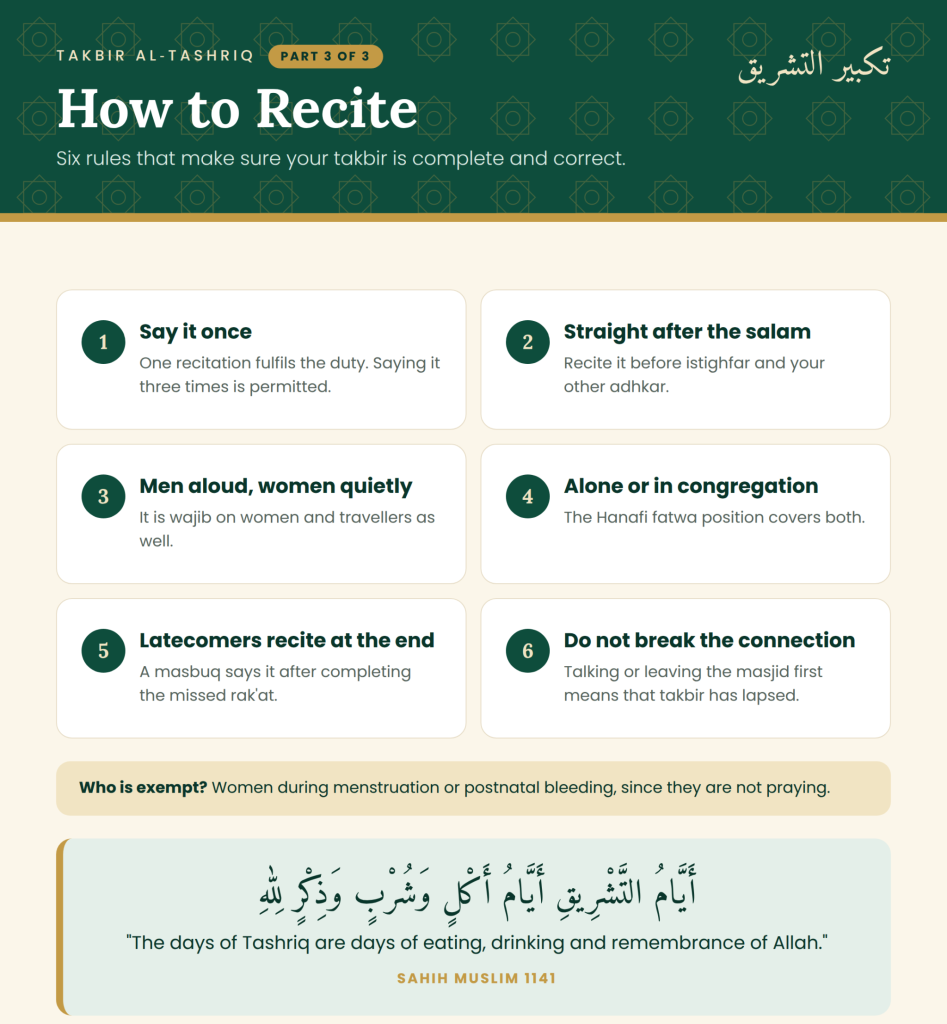
- Say it once. The obligation is fulfilled with one recitation. Saying it three times is permitted and common, but it is not required.
- Say it immediately after the salam. Recite it before istighfar, Ayat al-Kursi and other post-prayer adhkar.
- Do not break the connection with the prayer. If you speak, leave the masjid or deliberately nullify your wudu before reciting it, the time for that takbir lapses.
- Men recite it aloud; women recite it quietly. A woman lowers her voice so that only she can hear.
- Latecomers recite it at the end. A masbuq, who missed part of the congregation, recites it after completing the missed rak’at, not together with the imam.
- If the imam forgets, recite it anyway. The followers do not wait for the imam.
- Recite it after a missed prayer made up within these days. If a fard prayer from these five days is missed and made up before the days end, recite the takbir after it. A prayer from these days made up after they end does not carry the takbir. A prayer missed before these days and made up during them also does not carry it.
- Menstruating women are exempt. The takbir follows the prayer, and they are not praying.
- Do not recite it after sunnah, nafl or witr prayers. In the Hanafi school it is tied to the fard only.
The Meaning and Wisdom Behind Takbir al-Tashriq
A Response to Allah’s Guidance
The Quran links the sacrifice directly to takbir. Allah says of the sacrificial animals: “Thus has He subjected them to you so that you may declare Allah’s greatness for having guided you” (Al-Hajj 22:37). Takbir al-Tashriq is that declaration, repeated after every prayer. Its message is that the believer’s reward lies in taqwa and gratitude, not in the meat and blood.
Balancing Celebration and Remembrance
The Prophet ﷺ described these days as days of eating, drinking and remembrance of Allah. Islam does not ask the believer to withdraw from joy. It asks that joy stay anchored to Allah. Fasting is prohibited on the days of Tashriq for this reason. The meal becomes worship, and the takbir after each prayer keeps the celebration God-centred.
Uniting Pilgrims and Those at Home
Pilgrims at Mina spend these days stoning the jamarat and glorifying Allah. Imam al-Bukhari records that Sayyiduna Umar (may Allah be pleased with him) would say takbir in his tent at Mina. The people in the masjid heard him and joined in, and so did the people in the markets, until the whole of Mina resounded with takbir. Muslims who are not on Hajj share in this atmosphere through Takbir al-Tashriq. Across continents, the same words follow the same prayers on the same days.
The Story of Ibrahim and Ismail
A widely told account links each phrase of the takbir to the sacrifice of Prophet Ibrahim (peace be upon him). The angels are said to have proclaimed “Allahu Akbar” as they brought the ram. Ibrahim is said to have answered with the words of tawhid, and Ismail completed the praise. This account appears in later works and is not found in the authenticated hadith collections. It should be shared as a reflection, not as established narration. The legal basis of the takbir rests on the Quran, the Sunnah and the practice of the Companions.
Restricted and Unrestricted Takbir Compared
| Feature | Takbir Muqayyad (Restricted) | Takbir Mutlaq (Unrestricted) |
|---|---|---|
| When | Immediately after fard prayers | Any time: at home, in markets, while walking |
| Period | Fajr, 9 Dhul Hijjah to Asr, 13 Dhul Hijjah | From 1 Dhul Hijjah to the end of the days of Tashriq |
| Hanafi ruling | Wajib | Recommended |
| Basis | Practice of Ali, Umar and other Companions | Ibn Umar and Abu Hurayrah saying takbir in the markets (Sahih al-Bukhari) |
What Are the Common Mistakes?
Many Muslims stop after the day of Eid, but the Hanafi fatwa position continues until Asr on the 13th. Some people begin their dua first and remember the takbir later, when it should come first. Some confuse this takbir with the extra takbirs inside the Eid prayer. Others believe it is only for pilgrims, but it applies to every Muslim praying during these days.
About MWA Charity
MWA Charity is a 501(c)(3) nonprofit based in Chicago, USA, with a simple mission: to serve underprivileged communities with compassion, transparency, and lasting impact. Since our founding in 2018, we have built clean water wells and homes and provided food aid in some of the most underserved regions of Bangladesh, Africa, and beyond.
Our work was born from a legacy. Our founder grew up watching his father organize charity buses in Saudi Arabia to take pilgrims to Umrah, using the proceeds to support a girls’ school in Hyderabad, India. That sincerity still guides us today. We document every project, share regular updates with photo and video proof, and make sure every dollar goes where it is needed most. MWA Charity is committed to doing good with honesty, heart, and humility.
Multiply Your Reward in Dhul Hijjah
The Prophet ﷺ taught that no days are better for righteous deeds than the first ten days of Dhul Hijjah (Sahih al-Bukhari 969). Pair your takbir with a gift that keeps giving. A clean water well is a Sadaqah Jariyah that serves families long after Eid ends. Build a water well with MWA Charity
Frequently Asked Questions
What is Takbir al-Tashriq in English?
It means: Allah is the Greatest, Allah is the Greatest. There is no god but Allah, and Allah is the Greatest. Allah is the Greatest, and to Allah belongs all praise.
How many times should Takbir al-Tashriq be recited?
Once after each fard prayer is necessary in the Hanafi school. Reciting it three times is permitted.
When does Takbir al-Tashriq start and end?
It starts after Fajr on 9 Dhul Hijjah and ends after Asr on 13 Dhul Hijjah, covering 23 prayers.
Is Takbir al-Tashriq compulsory for women?
In the Hanafi fatwa position it is wajib for women as well. They recite it quietly.
Is Takbir al-Tashriq recited after sunnah prayers?
No. In the Hanafi school it is recited only after fard prayers, including Jumu’ah. It is also recommended after the Eid prayer.
What if I forget to say it after a prayer?
If you have not yet spoken or left the masjid, say it right away. Once the connection with the prayer is broken, that takbir lapses. Seek Allah’s forgiveness, and be careful after the remaining prayers.
Why is it called Tashriq?
The name comes from the practice of drying sacrificial meat in the sun at Mina. Hanafi jurists also use the word to mean raising the voice with takbir.
Can I recite Takbir al-Tashriq when praying alone at home?
Yes. In the Hanafi school it is wajib whether you pray alone or in congregation. The Hanbali school limits it to congregational prayers.
Final Comments
Takbir al-Tashriq turns 23 ordinary moments after prayer into five days of collective glorification. The wording is short enough for a child to learn and deep enough to hold the whole creed of Islam. Learn it, teach it to your family, and recite it from Fajr on the Day of Arafah until Asr on 13 Dhul Hijjah. May Allah accept our takbir, our prayers and our sacrifices.