
Zakat al-Fitr is an obligatory charity that every eligible Muslim pays at the end of Ramadan, before the Eid al-Fitr prayer, and the standard amount to give is the cash value of one saa’ of staple food, which works out to roughly $10 to $15 per person in 2026. Also called Fitrana or Sadaqat al-Fitr, this payment purifies the fasting person from any careless speech or actions committed during the month and provides food for the poor so they can share in the joy of Eid. The obligation applies to every family member, including infants, so the head of the household pays on behalf of everyone under their care.
Because the amount is tied to the current price of a basic food staple, the exact figure changes each year and differs from one country to another. Trusted bodies such as the Fiqh Council of North America and IMAM-US set the recommended value at $10 per person for 2026 in the United States, while other charities collect between $7 and $15 to give a comfortable margin. This guide explains what Zakat al-Fitr means, who must pay it, the precise amount for 2026, when the deadline falls, and who is entitled to receive it.
What Zakat al-Fitr Means
The word Fitr shares its root with Iftar, the breaking of the fast, so Zakat al-Fitr literally means the charity of breaking the fast. It was made obligatory by the Prophet Muhammad (peace be upon him) in the second year of Hijra, linked directly to the completion of Ramadan and the Eid prayer.
The purpose is twofold. Ibn Abbas (may Allah be pleased with him) reported that the Prophet made this charity obligatory to cleanse the fasting person from idle or indecent speech and to feed the needy. It is recorded in Abu Dawud and Ibn Majah. The second wisdom, as scholars note, is to spare the poor from having to ask for help on the day of Eid, allowing them to celebrate with dignity.
Zakat al-Fitr is not the same as the annual Zakat on wealth. The table below shows the key differences.
| Feature | Zakat al-Fitr (Fitrana) | Zakat al-Mal (Wealth) |
|---|---|---|
| Basis | Fixed amount per person | 2.5% of qualifying wealth |
| Who pays | Every Muslim with food beyond one day’s need | Muslims who meet the nisab threshold |
| Timing | End of Ramadan, before Eid prayer | Once a lunar year of savings is held for a year |
| Paid on behalf of | Every household member, including children | The individual owner of the wealth |
| Purpose | Purify the fast, feed the poor for Eid | Purify wealth, support eight eligible categories |
Who Must Pay Zakat al-Fitr
Zakat al-Fitr is due from every Muslim who owns food or wealth in excess of what they and their dependents need for the day and night of Eid. Wealth in the sense of the nisab is not required. If a person has a surplus of a single day’s food, the payment is owed.
The head of the household pays on behalf of every dependent. This includes:
- Adults and elderly parents under the person’s care
- Children of all ages, including a baby born before sunset on the last day of Ramadan
- A spouse and any dependents supported by the household
- Guests staying overnight on the eve of Eid, according to some scholars
A family of four, for example, pays four shares. If two guests stay overnight under their care on the eve of Eid, that household pays six shares in total. Even those who could not fast because of illness or age still owe Zakat al-Fitr if they meet the wealth condition.
How Much Zakat al-Fitr to Give in 2026
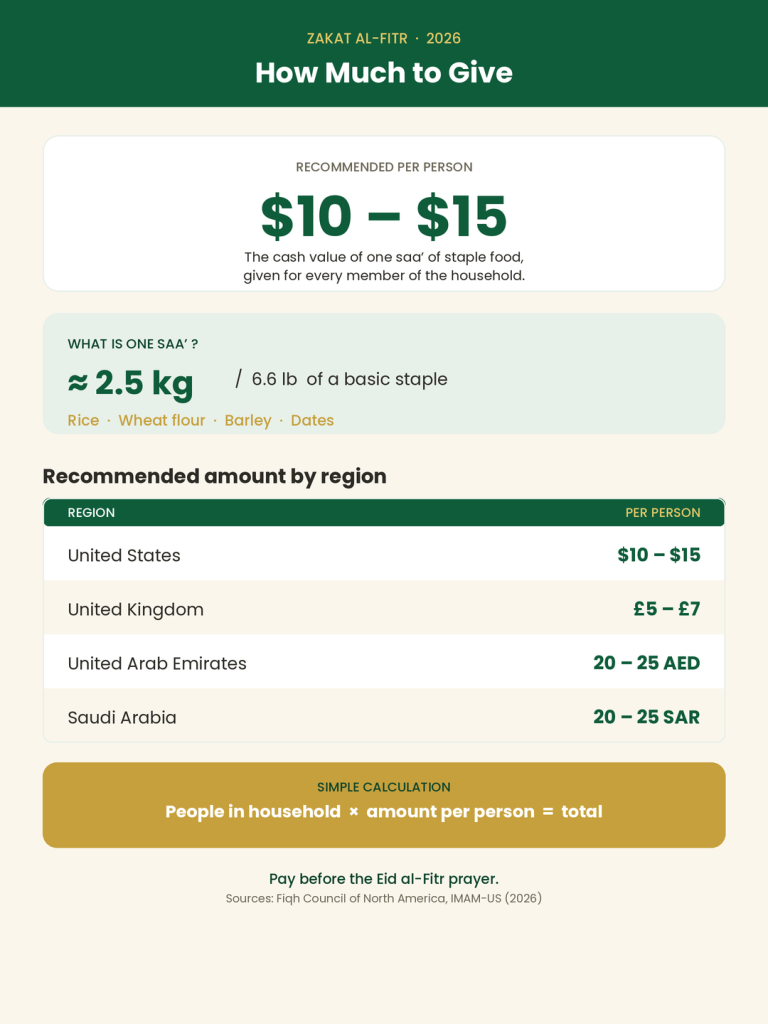
The amount is based on one saa’ of staple food. A saa’ is a volume measure equal to four madd, where a madd is roughly the amount held in two cupped hands. Converted to weight, one saa’ equals approximately 2.5 kilograms, or about 6.6 pounds, of a basic staple such as wheat flour, rice, barley, or dates.
Since the value depends on the market price of that food, scholars translate it into a cash figure each year. For 2026, the recommended figures from major organizations are as follows.
| Region | Recommended 2026 Amount (per person) | Source basis |
|---|---|---|
| United States | $10 to $15 | Fiqh Council of North America, IMAM-US ($10); broader charity range up to $15 |
| United Kingdom | £5 to £7 | Value of one saa’ of staple food |
| United Arab Emirates | 20 to 25 AED | Local staple food price |
| Saudi Arabia | 20 to 25 SAR | Local staple food price |
The Fiqh Council of North America based its 2026 recommendation on national food-cost data and set Zakat al-Fitr at $10 per person, while its separate Fidyah figure, paid for permanently missed fasts, was set at $15. IMAM-US reached the same $10 value by pricing 6.6 pounds of a common staple. Islamic Relief has historically collected a lower fixed figure of about $7, and several charities collect $10 to $15, so donors give a safe margin above the minimum.
A simple way to calculate your total:
Number of people in the household × amount per person = total Zakat al-Fitr owed.
Giving more than the minimum is permitted and encouraged, but the recommended amount fulfills the obligation. If you are unsure of the correct figure for your area, check the value published by your local mosque or a recognized fatwa council, since the price of the staple food determines the amount.
Paying in Food or in Cash
Scholars differ on whether the payment must be food or may be given as money.
The majority position, held by the Maliki and Shafi’i schools, is that Zakat al-Fitr should be paid as the staple food itself. The Hanafi school, along with Sheikh al-Islam Ibn Taymiyyah, permits paying the cash value when that better serves the recipient. Many contemporary fatwa councils adopt the cash position, especially for donors in Western countries or when funds are distributed to remote areas.
This is why paying Fitrana online has become common. When you give money to a charity, you are appointing it as your agent. The organization then buys and distributes the food on your behalf at the correct time, so the obligation is fulfilled as though you gave the food directly.
When to Pay Zakat al-Fitr
Timing is essential because paying late can change the nature of the charity.
- The obligation begins at sunset on the last day of Ramadan, the eve of Eid.
- It may be paid earlier during the final days of Ramadan, which most scholars consider preferable, so charities can distribute it in time.
- The deadline is before the Eid al-Fitr prayer on the morning of Eid.
The Prophet (peace be upon him) taught that the charity given before the Eid prayer is accepted as Zakat al-Fitr, while what is given after the prayer counts only as ordinary voluntary charity, or sadaqah. For 2026, donors are advised to pay one or two days before Eid so that food reaches families before the celebration.
Who Receives Zakat al-Fitr?
Zakat al-Fitr is given first and foremost to the poor and the needy. The majority of scholars hold that it is designated specifically for the Muslim poor, so their needs are met on the day of Eid.
A few further points apply:
- Giving to poor relatives who are not your direct dependents, such as siblings or cousins in need, is permitted and carries extra reward.
- It is preferable to give it to the poor of your own town or city, though charities may distribute it globally when local need is met.
- It may not be used to cover an organization’s operating costs unless a recognized religious authority has permitted it.
Is Zakat al-Fitr obligatory for children?
Yes. The head of the household pays it on behalf of every child, including a baby born before sunset on the last day of Ramadan.
Can I pay Zakat al-Fitr in cash?
Yes, according to the Hanafi school and many modern councils. The charity acts as your agent, buying and distributing the food on your behalf.
What happens if I pay after the Eid prayer?
Without a valid excuse, it counts as regular voluntary charity rather than Zakat al-Fitr, and the specific obligation is not fulfilled. You should pay it as soon as you remember.
How is the 2026 amount decided?
It equals the current market value of one saa’ of staple food, about 2.5 kilograms of rice, wheat, barley, or dates, which most bodies price at $10 to $15 per person this year.
Who is exempt from paying?
A person who does not have food or wealth beyond their own needs for the day and night of Eid is not obligated to pay.
Key Takeaways
Zakat al-Fitr is a small but obligatory charity that completes the spiritual work of Ramadan. Pay it before the Eid prayer, calculate one share for every member of your household, and base the amount on the value of one saa’ of staple food, which is $10 to $15 per person in most regions for 2026. Whether given as food or through a trusted charity in cash, it purifies the fast and ensures that every family can meet Eid with enough to eat.