

Zakat and Sadaqah are the two great forms of giving in Islam, and knowing the difference between them helps every Muslim fulfil their duty to Allah correctly. Zakat is the obligatory annual charity, fixed at 2.5 percent of qualifying wealth and required from every eligible Muslim. Sadaqah is voluntary charity, given freely in any amount, at any time, to anyone in need. Both purify the soul and bring reward, but only one is a pillar of Islam. Understanding how they differ protects your worship and multiplies your reward.
At Muslim Welfare Association (MWA), we help thousands of donors give both their Zakat and their Sadaqah with complete confidence. Every donation is handled as an amanah, a sacred trust, with 100 percent of your gift reaching those who need it and photo and video proof sent back to you. This guide explains what Zakat and Sadaqah are, how they differ, where they overlap, and how to give each one the way Allah intended, In Sha Allah.
What Is Zakat?
Zakat is the compulsory charity that Allah has made obligatory upon every Muslim who owns wealth above a set minimum. It is the third pillar of Islam and is mentioned in the Quran more than thirty times, almost always beside the command to establish prayer.
- Zakat is paid at a fixed rate of 2.5 percent once a person’s wealth reaches the Nisab, the minimum threshold, and has been held for one full lunar year, known as the Hawl. The word Zakat means purification and growth, because giving it cleanses a believer’s wealth and increases its blessings.
Allah made the obligation clear when He said:
“And establish prayer and give zakah and bow with those who bow [in worship and obedience].” Surah Al-Baqarah (2:43), Sahih International
Zakat can only be given to the eight categories of recipients that Allah named in Surah At-Tawbah (9:60), such as the poor, the needy, those in debt, and the stranded traveller.
What Is Sadaqah?
Sadaqah is any voluntary act of charity given purely to seek the pleasure of Allah. Unlike Zakat, it has no fixed amount, no set time, and no minimum wealth requirement. A wealthy person and a poor person can both give Sadaqah, and it can be offered to anyone in need.
Sadaqah is also far broader than money. The Prophet Muhammad (peace and blessings be upon him) taught that every good deed is a form of charity:
“Smiling in your brother’s face is charity.” Jami’ at-Tirmidhi 1956
He also encouraged even the smallest gift, saying:
“Protect yourself from the Fire, even with half a date [given in charity].” Sahih al-Bukhari and Sahih Muslim
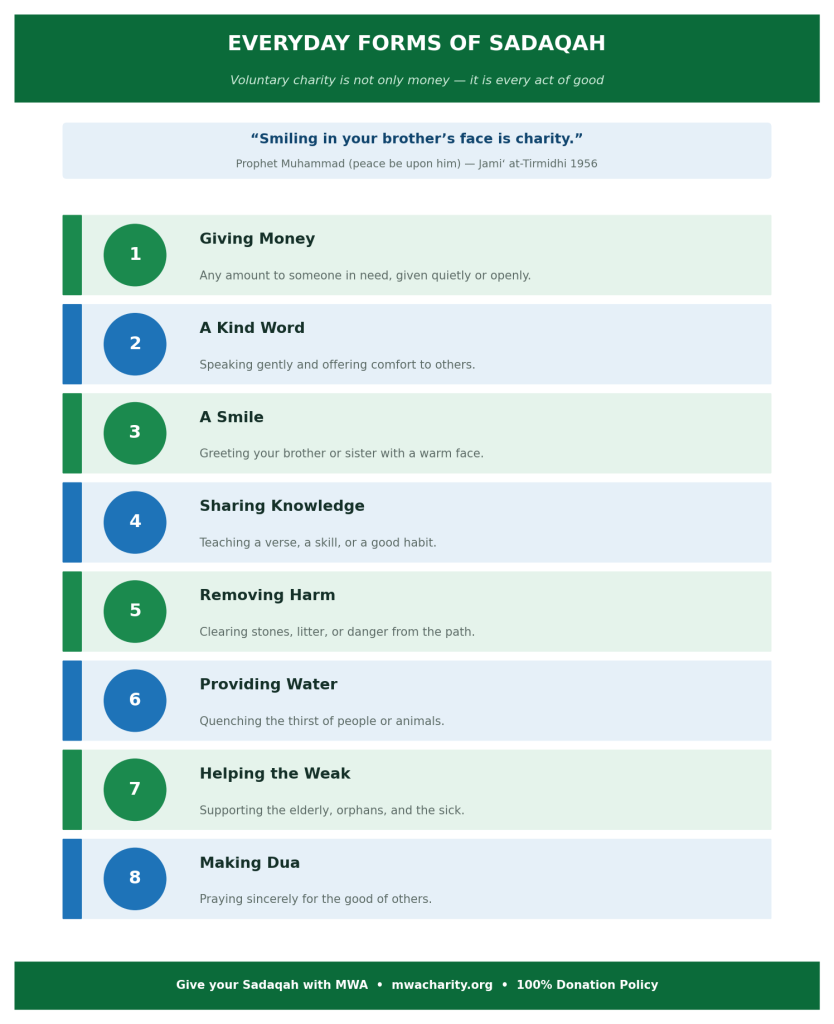
Because it is so flexible, Sadaqah is a door of reward that stays open every day of the year.
Zakat vs Sadaqah: The Key Differences
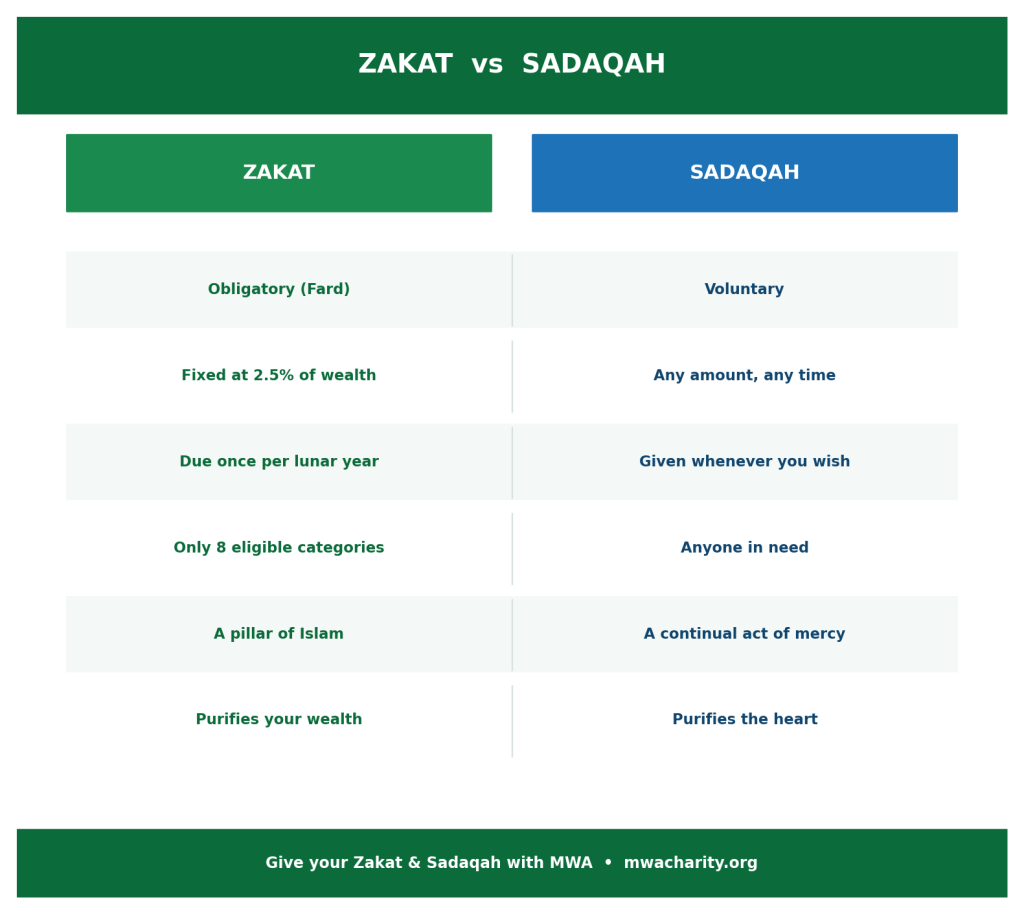
The simplest way to understand the two is this: Zakat is a duty, while Sadaqah is a gift. Zakat is fixed, obligatory, and restricted to certain recipients. Sadaqah is free, voluntary, and open to all. The table below sets out the main differences clearly.
| Feature | Zakat | Sadaqah |
|---|---|---|
| Ruling | Obligatory (Fard) | Voluntary (Nafl) |
| Amount | Fixed at 2.5 percent of wealth | Any amount you choose |
| Timing | Once every lunar year | Any time, as often as you wish |
| Condition | Only if wealth is above the Nisab for one year | No wealth condition at all |
| Recipients | 8 categories named in the Quran (9:60) | Anyone in need |
| Status | A pillar of Islam | A continual act of mercy |
| Form | Money and wealth only | Money, time, kindness, and good deeds |
| Purpose | Purifies your wealth | Purifies your heart |
Is Sadaqah Obligatory or Voluntary?
Sadaqah is voluntary, not obligatory. There is no sin in not giving Sadaqah, and there is no fixed amount attached to it. This is the opposite of Zakat, which is a binding duty on every Muslim whose wealth reaches the Nisab.
There is one important exception in name. Sadaqah al-Fitr, also called Zakat al-Fitr or Fitrana, is obligatory. It is a small, fixed charity of food or its value, given by the head of a household before the Eid al-Fitr prayer at the end of Ramadan. Although it carries the word Sadaqah, it is a required charity, not a voluntary one. Outside of this, general Sadaqah remains a free and rewarding act of generosity.
What Is Sadaqah Jariyah?
Sadaqah Jariyah is a special form of voluntary charity that keeps giving reward long after the donation is made, and even after the giver has passed away. The word Jariyah means flowing or continuous. When you fund something that keeps benefiting people, the reward keeps flowing back to you.
The Prophet Muhammad (peace be upon him) said:
“When a person dies, his deeds come to an end except for three: ongoing charity (Sadaqah Jariyah), beneficial knowledge, or a righteous child who prays for him.” Sahih Muslim 1631
Common examples of Sadaqah Jariyah include:
- Building a water well that quenches thirst for years to come.
- Sponsoring the printing of the Quran or Islamic books.
- Helping to build a mosque, a school, or an orphanage.
- Supporting education so that beneficial knowledge continues to spread.
At MWA, many of our projects, from water wells to mosques and Quran sponsorship, are Sadaqah Jariyah. They allow your giving to become a legacy of reward that outlives you, In Sha Allah.
Similarities Between Zakat and Sadaqah
Although Zakat and Sadaqah differ in ruling, they share a common spirit. Both are acts of worship that draw a believer closer to Allah and lift the burden of those in need. Their shared qualities include:
- Both are given for the sake of Allah and are rewarded by Him.
- Both purify the giver, freeing the heart from greed and attachment to wealth.
- Both help the poor and the vulnerable, strengthening the bonds of the Ummah.
- Both increase blessing, never loss. The Prophet (peace be upon him) said, “Charity does not decrease wealth” (Sahih Muslim 2588).
The Quran describes the beauty of giving with a powerful image, comparing charity to a single seed that grows into seven ears, each bearing a hundred grains (Surah Al-Baqarah, 2:261). This is how Allah multiplies the reward of every sincere gift.
Can Sadaqah Replace Zakat?
No. Sadaqah cannot replace Zakat. This is one of the most common misunderstandings about Islamic giving. Zakat is a specific obligation with its own rules on rate, timing, and eligible recipients. Giving voluntary Sadaqah, no matter how generous, does not fulfil the duty of Zakat.
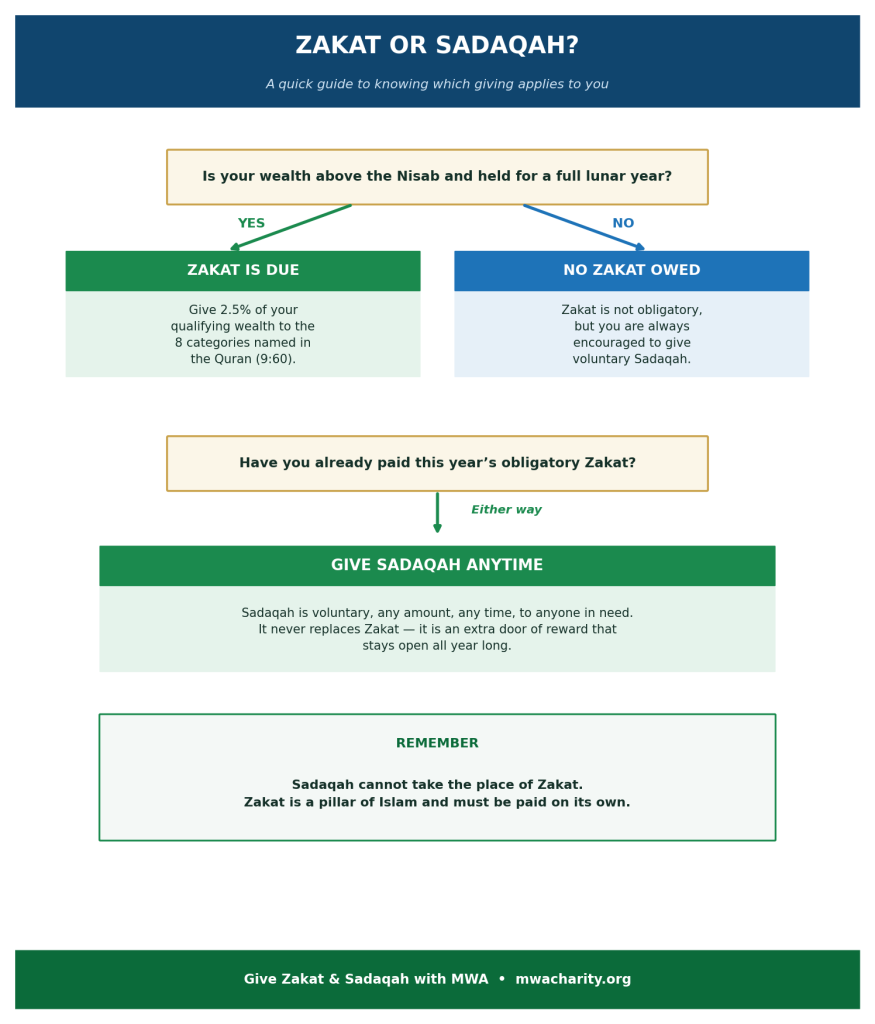
If your wealth is above the Nisab and has been held for a full lunar year, you must pay your 2.5 percent Zakat separately. You are then warmly encouraged to give as much Sadaqah as you wish on top of it. Think of Zakat as the obligation you must meet, and Sadaqah as the extra generosity that raises your rank with Allah.
Which Should You Give First?
Zakat comes first because it is a duty owed to Allah and to the poor. Once your Zakat is calculated and paid for the year, you are free to give Sadaqah whenever your heart moves you.
A believer who pays Zakat on time and then gives regular Sadaqah has combined obligation with generosity. This is the way of the Prophet Muhammad (peace be upon him), who was the most generous of people and gave charity constantly, in ways both large and small.
Give Your Zakat and Sadaqah with MWA
Whether you are fulfilling the obligation of Zakat or opening the door of Sadaqah, your giving deserves to reach the people it was meant for. Muslim Welfare Association is a registered 501(c)(3) nonprofit that has served humanity since 2012, delivering aid to struggling families across Africa, Bangladesh, India, and Pakistan.
When you give through MWA, you can expect:
- A 100 percent donation policy so the full value of your gift reaches those in need.
- Photo and video proof of your donation will be sent to you after distribution.
- Zakat-eligible and Sadaqah Jariyah projects, including water wells, Quran sponsorship, orphan support, and mosque building.
Families in these regions are forced to choose between food, medicine, and shelter, choices no family should ever have to make. Your Zakat can meet an obligation today, and your Sadaqah can become a source of endless reward, In Sha Allah.
Give your Zakat and Sadaqah now and let your wealth become a means of mercy. May Allah accept your giving, purify your wealth, and reward you abundantly. Ameen.
What is the difference between Zakat and Sadaqah?
The main difference is that Zakat is obligatory and Sadaqah is voluntary. Zakat is a pillar of Islam, fixed at 2.5 percent of qualifying wealth, paid once a lunar year, and given only to eight categories of recipients named in the Quran. Sadaqah is a gift of any amount, given at any time, to anyone in need. All Zakat is charity, but not all charity is Zakat.
Is Sadaqah obligatory?
General Sadaqah is voluntary, so there is no sin in not giving it and no fixed amount is required. The one exception is Sadaqah al-Fitr (Zakat al-Fitr), a small obligatory charity of food or its value given before the Eid al-Fitr prayer at the end of Ramadan.
Can I give Sadaqah instead of Zakat?
No. Sadaqah cannot replace Zakat. Zakat is a specific obligation with its own rules on amount, timing, and eligible recipients. If your wealth is above the Nisab for a full lunar year, you must pay your 2.5 percent Zakat separately, and you may give Sadaqah on top of it.
What is Sadaqah Jariyah?
Sadaqah Jariyah is an ongoing or continuous charity that keeps earning reward long after it is given, even after the giver has died. The Prophet Muhammad (peace be upon him) said a person’s reward continues through ongoing charity, beneficial knowledge, and a righteous child who prays for him (Sahih Muslim 1631). Water wells, mosques, and Quran sponsorship are common examples.
How much is Sadaqah?
There is no fixed amount for Sadaqah. You can give as little or as much as you wish, whenever you wish. Even a small act, such as giving half a date or offering a kind word, counts as Sadaqah in Islam. This is different from Zakat, which is fixed at 2.5 percent of qualifying wealth.
Who can receive Sadaqah?
Sadaqah can be given to anyone in need, including family members, neighbours, and even non-Muslims. This is much broader than Zakat, which can only be given to the eight categories of recipients named in the Quran. Giving Sadaqah to close relatives in need can carry a double reward.
Is Zakat a type of Sadaqah?
In a broad sense, Zakat is a form of charity, and the Quran sometimes uses the word Sadaqah to refer to obligatory Zakat. In everyday use, however, Zakat means the obligatory annual charity, while Sadaqah means voluntary charity. So Zakat is charity, but it is a specific, compulsory kind with its own strict rules.
Which is better, Zakat or Sadaqah?
Zakat takes priority because it is an obligation and must be paid first. Fulfilling a duty owed to Allah is more important than a voluntary act. Once Zakat is paid, giving Sadaqah is a beautiful way to earn extra reward and raise your rank with Allah. The ideal is to pay Zakat on time and give Sadaqah regularly alongside it.