
To calculate your Zakat in 2026, add up everything you own that qualifies (cash, gold, silver, savings, shares, and business stock), subtract the debts you owe, and pay 2.5% of what remains if your total sits above the Nisab threshold for one lunar year. Zakat is the third pillar of Islam and a yearly act of worship that purifies your wealth and lifts a real burden from families in need. This guide gives you the exact 2026 Nisab values, what counts and what does not, and a worked example you can follow in minutes. When your Zakat is ready, MWA (Muslim Welfare Association) delivers it to vulnerable families across Africa, India, Pakistan, and Bangladesh, with photo and video proof of every project.
Zakat is not a tax, and it is not a favour. Allah describes it as a right the poor hold over the wealth He has given you. Paying it correctly cleanses what you keep and brings barakah into your home. In Surah At-Tawbah, Allah instructs the Prophet ﷺ to take a charity from the believers’ wealth that purifies them and causes them to increase (At-Tawbah 9:103). The steps below make the whole calculation clear, even if this is your first year paying.
What is Zakat in simple terms?
Zakat is an obligatory yearly charity of 2.5% on the surplus wealth a Muslim has held for one lunar year. The word itself means purification and growth. By giving a small share of what you have saved, you purify the rest. The Prophet ﷺ taught this when he sent Mu’adh ibn Jabal to Yemen and told him that Allah has made charity obligatory upon the rich, to be taken from them and returned to the poor among them (Sahih al-Bukhari and Sahih Muslim).
Who has to pay Zakat in 2026?
Zakat is due on every adult Muslim of sound mind who owns wealth above the Nisab for one full lunar year. If you meet all four conditions below, Zakat is obligatory on you this year.
| Condition | What it means |
|---|---|
| Muslim | Zakat is an act of worship for Muslims |
| Adult and sane | You have reached puberty and are of sound mind |
| Above Nisab | Your net zakatable wealth meets or passes the threshold |
| One lunar year (Hawl) | That wealth has stayed above Nisab for a full Islamic year |
If your wealth sits below the Nisab, you owe no Zakat this year. You may instead be eligible to receive it.
What is Nisab, and what are the 2026 values?
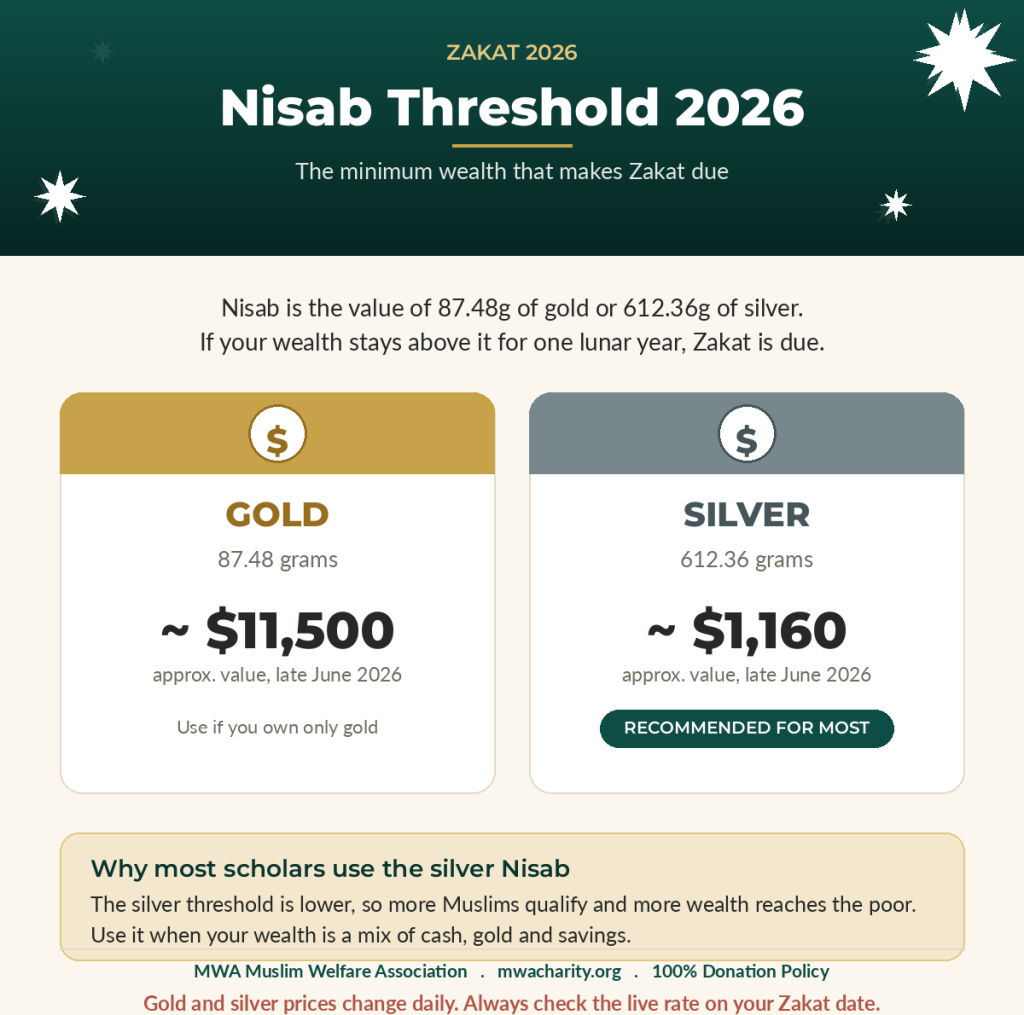
Nisab is the minimum amount of wealth you must own before Zakat becomes due. The Prophet ﷺ set it at the value of 87.48 grams of gold or 612.36 grams of silver. Because metal prices move daily, the cash value of Nisab changes throughout the year.
| Nisab basis | Weight | Approx. value (late June 2026) |
|---|---|---|
| Gold | 87.48 grams | about $11,500 USD |
| Silver | 612.36 grams | about $1,160 USD |
Most scholars advise using the silver Nisab because it is the lower threshold, so more Muslims qualify, and more wealth reaches the poor. Use the silver value when your wealth includes cash, gold, and savings. Use the gold Nisab only if you own gold alone. Prices have been volatile in 2026, so confirm the live rate on the day you calculate.
What is Hawl, the Zakat year?
Hawl is the requirement that your wealth stays above the Nisab for one full lunar year before Zakat is due. The Islamic year runs about 354 days, which is around 11 days shorter than the solar year. Your Zakat date is the day your wealth first reached the Nisab. Each year, on that same date, you calculate and pay. If your wealth dipped in between but is above the Nisab on your date, Zakat is still due. Many Muslims choose Ramadan for the extra reward, as long as they keep a consistent date.
Which assets are zakatable, and which are exempt?
Zakat applies to wealth that grows or has the potential to grow, held beyond your basic needs.
| You pay Zakat on | You do not pay Zakat on |
|---|---|
| Cash at home, bank, and digital wallets | Your primary home |
| Savings and deposits | Your personal car |
| Gold and silver (incl. jewellery) | Everyday clothing |
| Shares, funds, and investments | Household furniture |
| Business stock for resale | Work tools and equipment |
| Money owed to you, crypto, rental profit | Food and daily essentials |
Whether worn gold jewellery is zakatable depends on your school of thought. The Hanafi school includes all jewellery. The Shafi’i, Maliki, and Hanbali schools generally exempt jewellery from regular use. If unsure, the safer and more rewarding choice is to include it.
What can you deduct before calculating?
You can subtract immediate debts and bills you owe before working out your Zakat. This usually includes money owed to others, your current rent or mortgage payment due, an overdue loan instalment, and unpaid bills. Most scholars allow you to deduct only short-term debts due now, rather than the full balance of a long-term loan, such as a 25-year mortgage.
How to calculate your Zakat in 2026
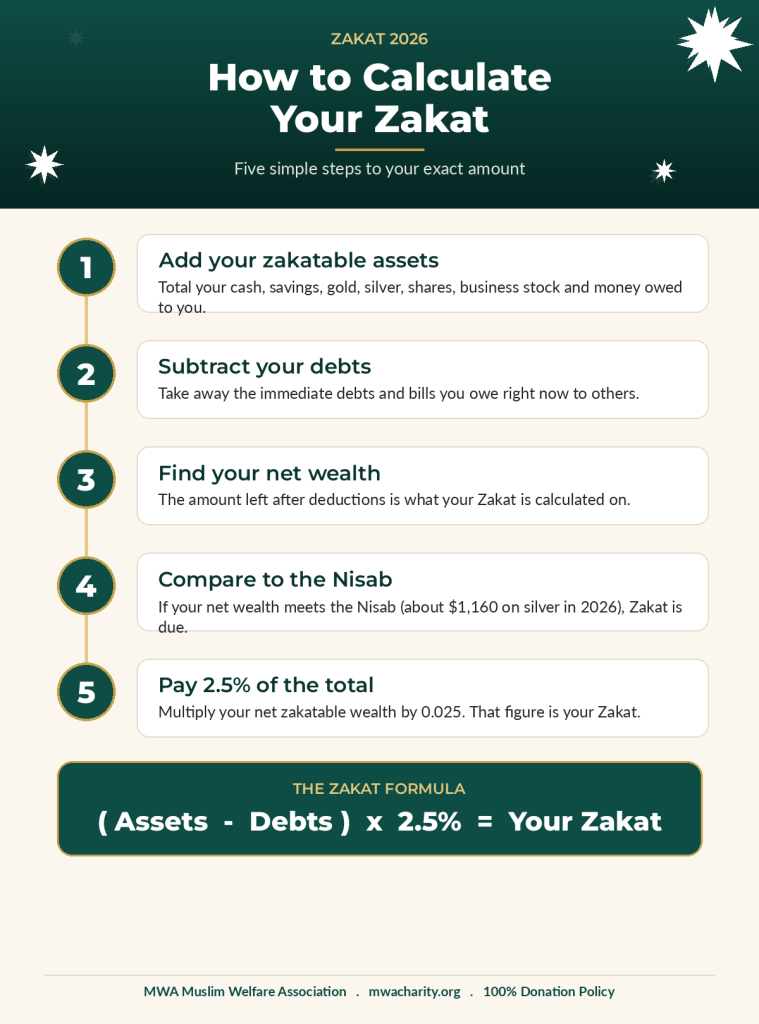
Calculating Zakat takes five clear steps.
- Add your zakatable assets. Total your cash, savings, gold, silver, shares, business stock and money owed to you.
- Subtract your deductible debts. Take away the immediate debts and bills you owe now.
- Find your net zakatable wealth. The figure left after deductions is what your Zakat is based on.
- Compare it to the Nisab. If your net wealth meets the Nisab (about $1,160 on silver in 2026), Zakat is due.
- Pay 2.5% of the total. Multiply your net wealth by 0.025. That figure is your Zakat.
The formula in one line is:
(Total zakatable assets − Deductible debts) × 2.5% = Your Zakat
A worked example you can follow
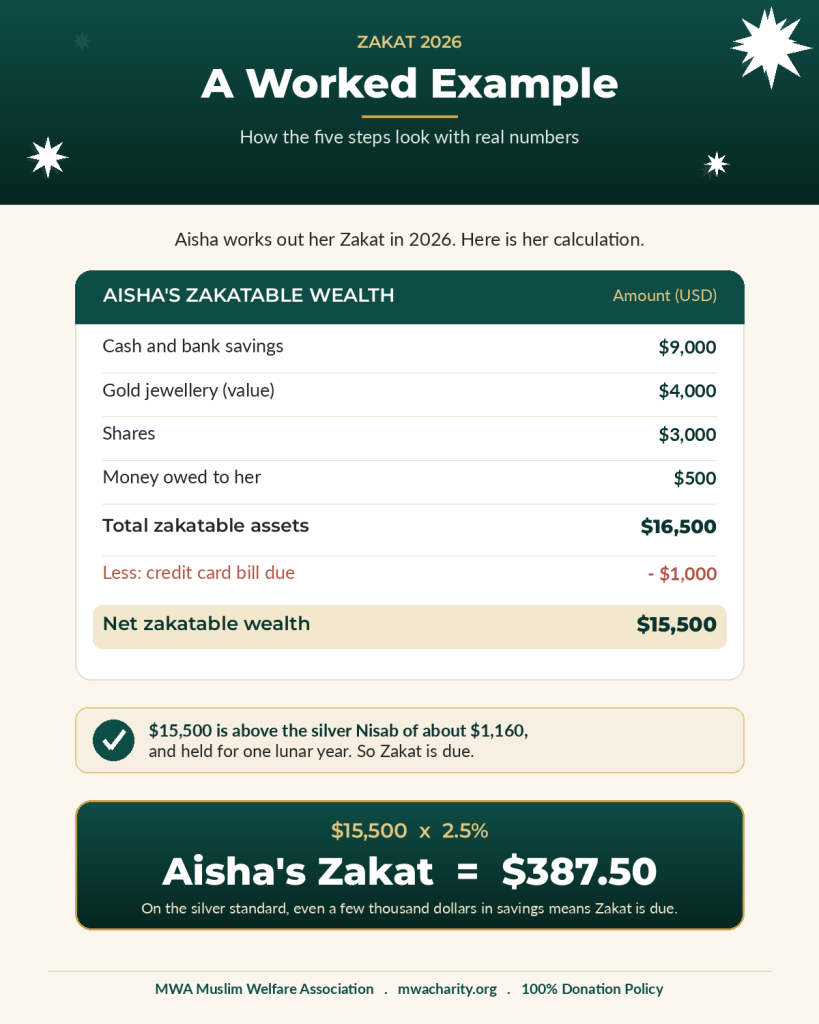
Here are the steps with real numbers for a donor named Aisha.
| Item | Amount |
|---|---|
| Cash and bank savings | $9,000 |
| Gold jewellery (value) | $4,000 |
| Shares | $3,000 |
| Money owed to her | $500 |
| Total zakatable assets | $16,500 |
| Less: credit card bill due | $1,000 |
| Net zakatable wealth | $15,500 |
Aisha’s net wealth of $15,500 is well above the silver Nisab of about $1,160, and she has held it for a full lunar year. Her Zakat is $15,500 × 2.5% = $387.50.
What about gold, shares, crypto, and pensions?
For gold, weigh it, multiply by the current price per gram, and pay 2.5% of the value. For shares held long term, pay 2.5% of their market value, or of the zakatable portion if you follow a method that separates trading assets. Cryptocurrency held as an asset is treated like cash, so pay 2.5% of its value. Many scholars include accessible pension balances even when early withdrawal carries a penalty, though rulings differ on locked funds. For complex cases, ask a qualified scholar.
Who can receive your Zakat? The eight categories
Allah named the only eight groups eligible to receive Zakat in Surah At-Tawbah 9:60. Giving outside these categories does not fulfil the obligation, so it matters where your Zakat goes. The eight are the poor (Al-Fuqara), the needy (Al-Masakin), those employed to collect Zakat, those whose hearts are to be reconciled, those in bondage, those in debt, those striving in the cause of Allah, and the stranded traveller. A trustworthy charity makes sure your Zakat reaches one of these groups.
Where can you give your Zakat with confidence?
Give your Zakat to a charity that distributes it to the eight eligible categories and shows you where it went. MWA (Muslim Welfare Association) has served vulnerable communities since 2012 as a registered 501(c)(3) nonprofit in the United States (EIN 83-0841269). Your Zakat through MWA reaches struggling families in Bangladesh, across Africa, and in India and Pakistan, with photo and video proof of every project. You can calculate your amount with this guide and give it the same day, so a family in need feels the relief sooner. May Allah accept your Zakat and bless your wealth.
How much is Zakat in 2026?
Zakat is 2.5% of your net zakatable wealth. You owe it if that wealth stays above the Nisab, which in 2026 is about $11,500 on the gold standard or about $1,160 on the silver standard, with values changing as metal prices move.
Do I pay Zakat if I have debt?
You can deduct immediate debts and bills due now before calculating. If your wealth after deductions still meets the Nisab, Zakat is due on that net amount.
Can I pay my Zakat during Ramadan?
Yes. Many Muslims pay in Ramadan for the extra reward, but Zakat is tied to your own lunar year date. Choose a fixed date and keep to it each year.
Is Zakat the same as Sadaqah?
No. Zakat is an obligatory yearly payment of 2.5% on qualifying wealth. Sadaqah is a voluntary charity you can give any time, in any amount.