

Zakat is the obligatory annual charity in Islam, and it is the third pillar of the faith. It asks every eligible Muslim to give a fixed share, 2.5 percent, of their qualifying wealth to those in need. The word Zakat means purification and growth. By giving it, a believer purifies their wealth, cleanses the heart from greed, and helps lift struggling families out of hardship. Allah pairs Zakat with prayer again and again in the Quran, which shows how central it is to a complete Islamic life.
At the Muslim Welfare Association (MWA), we see the beauty of Zakat every single day. When you give your Zakat through us, 100 percent of your donation reaches the people it was meant for, and you receive photos and videos as proof of the impact. This guide explains what Zakat is, who must pay it, who can receive it, how to calculate it, and how your giving becomes a source of lasting reward, In Sha Allah.
What Is Zakat in Islam?
In Islam, Zakat is a compulsory act of worship (ibadah) and a financial duty placed upon every Muslim who owns wealth above a set minimum. It is one of the Five Pillars of Islam, sitting alongside the declaration of faith (Shahada), prayer (Salah), fasting in Ramadan (Sawm), and pilgrimage (Hajj).
Zakat is not a tax, and it is not a favour to the poor. It is a right that Allah has placed in the wealth of the rich for the benefit of the needy. A Muslim pays Zakat once their wealth reaches a threshold called the Nisab and they have held that wealth for one full lunar year, known as the Hawl. The standard rate is 2.5 percent of that qualifying wealth.
The Prophet Muhammad (peace and blessings be upon him) made the place of Zakat clear in a well-known hadith:
“Islam has been built on five [pillars]: testifying that there is no deity worthy of worship except Allah and that Muhammad is the Messenger of Allah, establishing the prayer, paying the Zakat, making the pilgrimage to the House, and fasting in Ramadan.” Reported by Abdullah ibn Umar (may Allah be pleased with him), Sahih al-Bukhari 8 and Sahih Muslim 16
Zakat in the Quran
Zakat is mentioned in the Holy Quran more than thirty times, and on many occasions it appears directly after the command to establish prayer. This pairing is deliberate. It links a Muslim’s relationship with Allah through Salah to their relationship with society through giving.
One of the clearest verses is:
“And establish prayer and give zakah and bow with those who bow [in worship and obedience].” Surah Al-Baqarah (2:43), Sahih International
Allah also promises that whatever good a believer sends forward is never lost:
“And establish prayer and give zakah, and whatever good you put forward for yourselves, you will find it with Allah.” Surah Al-Baqarah (2:110), Sahih International
These verses remind us that Zakat is an investment with Allah. Wealth given for His sake returns as barakah in this life and as a reward in the hereafter.
Why Is Zakat Important?
Zakat is important because it is a direct command from Allah and a test of sincerity in faith. Holding back wealth can harden the heart, while giving it softens the soul and strengthens trust in Allah as the true Provider. Its importance can be understood on three levels.
- Spiritual importance. Zakat purifies wealth and frees the giver from greed and attachment to money. It is an act of obedience that draws a believer closer to Allah.
- Social importance. Zakat redistributes wealth from those who have plenty to those who have little. It eases poverty, restores dignity, and binds the Ummah together in mutual care.
- Economic importance. When wealth circulates to the poor instead of sitting idle, families can buy food, pay debts, start small trades, and rebuild their lives.
The Prophet Muhammad (peace be upon him) taught that charity never reduces wealth. Giving Zakat is not a loss. It is a way of placing your trust in Allah, who multiplies the reward of every sincere act of giving.
Types of Zakat
There are two main types of Zakat in Islam. Both are obligatory, but they apply at different times and in different ways. The table below explains each clearly.
| Type of Zakat | What It Is | When It Is Due | Who Pays It |
|---|---|---|---|
| Zakat al-Mal (Zakat on wealth) | The annual 2.5 percent due on savings, gold, silver, cash, business stock, and investments held above the Nisab | Once every lunar year (after the Hawl is complete) | Every adult Muslim whose wealth is above the Nisab |
| Zakat al-Fitr (Fitrana) | A small, fixed charity of food (or its value) given before the Eid al-Fitr prayer | At the end of Ramadan, before Eid prayer | The head of every household, on behalf of each member, including children |
Zakat al-Mal is the form most people mean when they say “Zakat.” Zakat al-Fitr is smaller and is given so that even the poorest can celebrate Eid with food and dignity. Beyond these obligatory forms, many Muslims also give Sadaqah and Sadaqah Jariyah, which are voluntary acts of ongoing charity.
Who Is Eligible to Pay Zakat?
Zakat becomes obligatory on a person when they meet a clear set of conditions. You are eligible to pay Zakat if all of the following apply to you.
- You are a Muslim. Zakat is an act of Islamic worship and is required only of Muslims.
- You are an adult of sound mind. Most scholars hold that Zakat is due once a person reaches maturity.
- You own wealth above the Nisab, the minimum threshold of wealth.
- You have held that wealth for one full lunar year (Hawl).
If your wealth stays above the Nisab for a complete lunar year, Zakat is due at 2.5 percent. If your wealth drops below the Nisab during the year, Zakat is not owed for that cycle.
Understanding the Nisab
The Nisab is the minimum amount of wealth a Muslim must own before Zakat becomes due. The Prophet Muhammad (peace be upon him) set it at a value equal to either of the following:
- 87.48 grams of gold, or
- 612.36 grams of silver
Because gold and silver prices change every day, the cash value of the Nisab changes too. Many scholars recommend using the silver standard because it gives a lower threshold and allows more Muslims to give, which means more help reaches the poor. Always check the current rate before you calculate.
How to Calculate Your Zakat
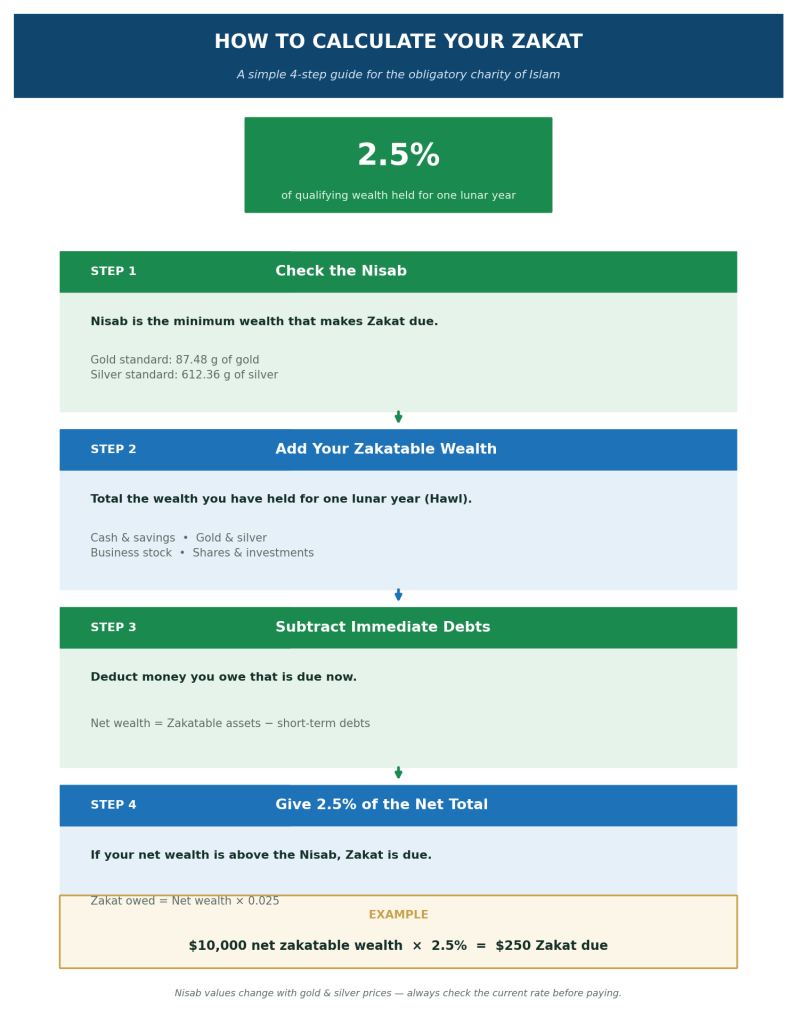
Calculating Zakat is simpler than many people expect. You add up the wealth you have held for one lunar year, subtract your immediate debts, and give 2.5 percent of what remains if it is above the Nisab.
Here is the method in four steps:
- Check the Nisab. Find the current value of 87.48 grams of gold or 612.36 grams of silver.
- Add your zakatable wealth. Include cash, savings, gold, silver, business stock, and shares.
- Subtract immediate debts. Deduct the money you owe that is due now to find your net wealth.
- Give 2.5 percent. If your net wealth is above the Nisab, multiply it by 0.025.
For example, if your net zakatable wealth is 10,000 US dollars, your Zakat would be 250 US dollars (10,000 x 2.5 percent). If you are ever unsure about a specific asset, it is best to consult a trusted scholar.
Who Is Eligible to Receive Zakat? (The 8 Categories in the Quran)
Zakat cannot be given to just anyone. Allah Himself named the people who may receive it. This is one of the most important rulings in Zakat, because giving to the wrong recipient can leave the obligation unfulfilled.
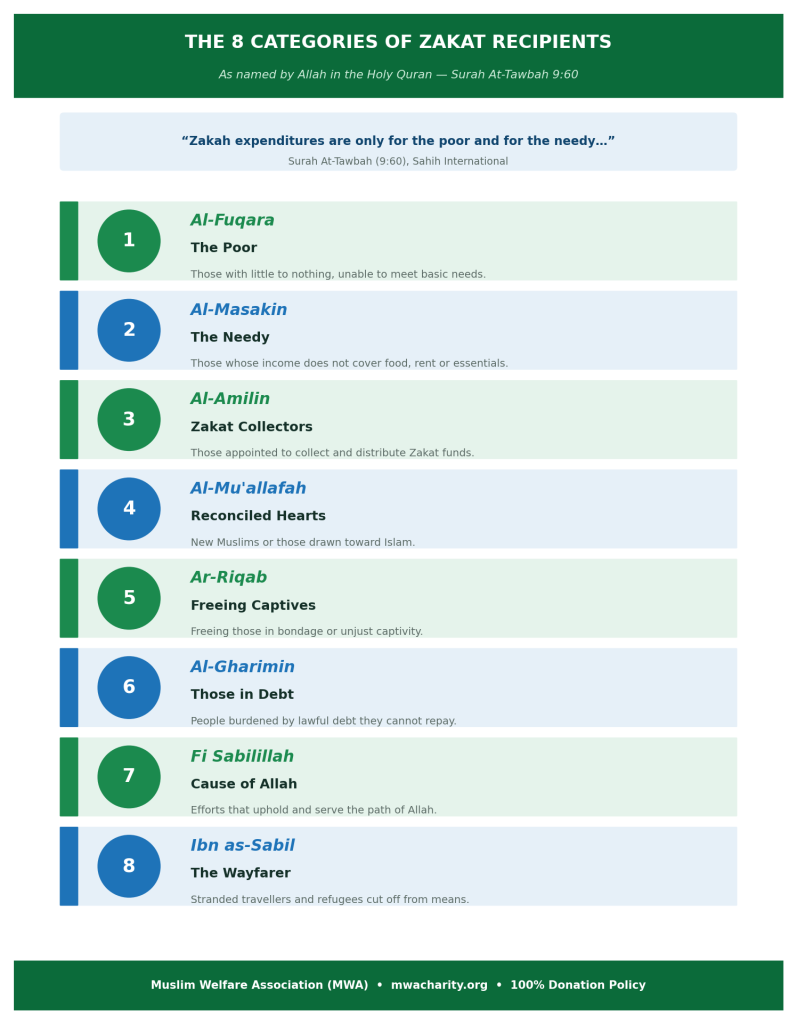
The Quran lists exactly eight categories of eligible recipients:
“Zakah expenditures are only for the poor and for the needy and for those employed to collect [zakah] and for bringing hearts together [for Islam] and for freeing captives [or slaves] and for those in debt and for the cause of Allah and for the [stranded] traveler, an obligation [imposed] by Allah. And Allah is Knowing and Wise.” Surah At-Tawbah (9:60), Sahih International
The eight categories are:
- Al-Fuqara (the poor) who have little or nothing.
- Al-Masakin (the needy) whose income cannot cover their basic needs.
- Al-Amilin (Zakat collectors) were appointed to gather and distribute the funds.
- Al-Mu’allafah (those whose hearts are to be reconciled), such as new Muslims.
- Ar-Riqab (freeing captives) from bondage or unjust captivity.
- Al-Gharimin (those in debt) who cannot repay lawful debts.
- Fi Sabilillah (in the cause of Allah), efforts that serve His path.
- Ibn as-Sabil (the wayfarer), the stranded traveller, and the refugee.
Who Cannot Receive Your Zakat?
Just as Islam names who can receive Zakat, it also sets clear limits. Your Zakat should not be given to:
- Your immediate dependents, such as your spouse, parents, grandparents, children, and grandchildren, are already responsible for them.
- The wealthy, or anyone who already owns wealth above the Nisab.
- Non-Muslims, who may instead receive your voluntary Sadaqah.
- The family of the Prophet Muhammad (peace be upon him), the Banu Hashim.
A beautiful principle from the Sunnah guides how Zakat should flow. When the Prophet (peace be upon him) sent Mu’adh ibn Jabal (may Allah be pleased with him) to Yemen, he instructed that Zakat be “taken from the rich among them and given back to the poor among them” (Sahih al-Bukhari 1395). This is the heart of Zakat: wealth moving from those who have to those who need.
Is Zakat Charity?
Zakat is a form of charity, but it is not the same as ordinary charity. Zakat is obligatory (Fard), fixed in amount, due once a year, and limited to eight categories of recipients. General charity, known as Sadaqah, is voluntary, can be any amount, given at any time, and offered to anyone in need.
In short, all Zakat is charity, but not all charity is Zakat. Think of Zakat as the obligatory floor of giving that every able Muslim must meet, while Sadaqah is the open door of generosity that a believer can walk through as often as they wish.
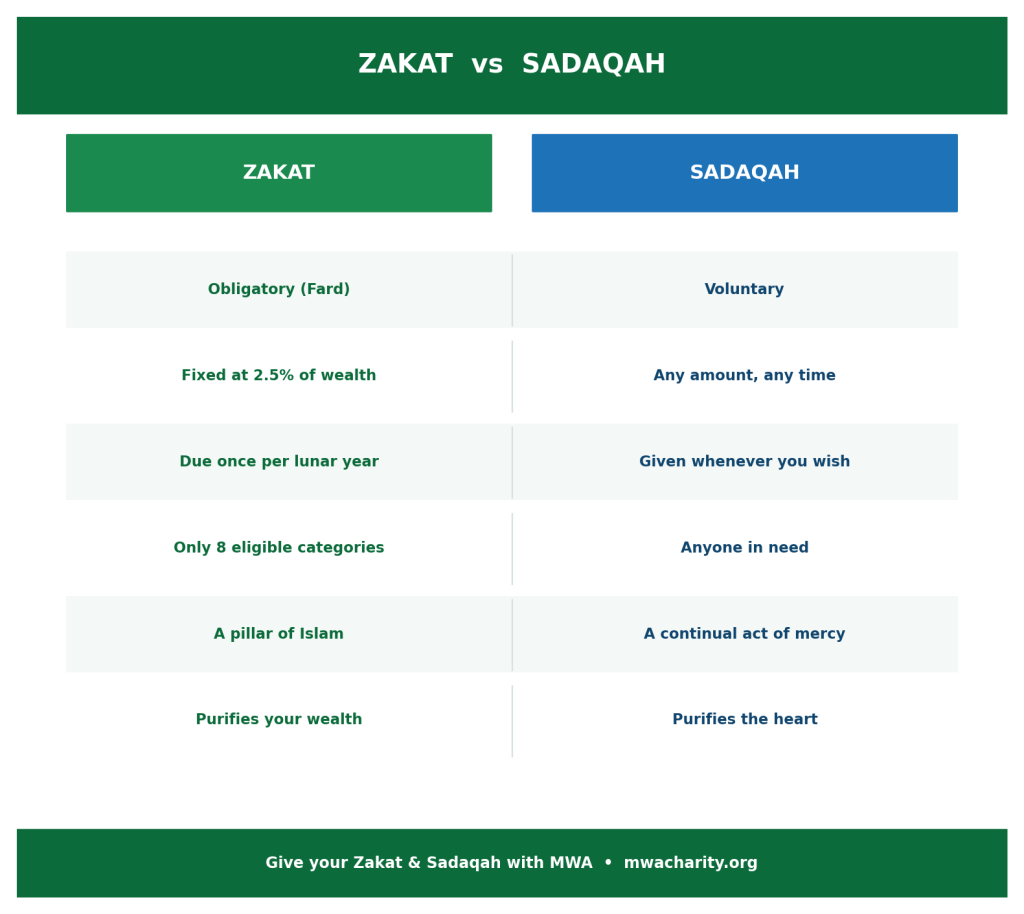
| Zakat | Sadaqah | |
|---|---|---|
| Ruling | Obligatory (Fard) | Voluntary |
| Amount | Fixed at 2.5 percent | Any amount |
| Timing | Once per lunar year | Any time |
| Recipients | 8 named categories | Anyone in need |
| Status | A pillar of Islam | A continual act of mercy |
Give Your Zakat with MWA and Witness the Reward
Your Zakat is an amanah, a sacred trust, and it deserves to be handled with honesty and care. At Muslim Welfare Association, a registered 501(c)(3) nonprofit serving humanity since 2012, we make sure every dollar of your Zakat reaches an eligible recipient under the categories Allah named in the Quran.
When you give your Zakat through MWA, you can expect:
- A 100 percent donation policy, so the full value of your Zakat reaches the poor and needy.
- Photo and video proof of your donation in action, sent to you after distribution.
- Trusted, eligible projects that support orphans, refugees, and struggling families across Africa, Bangladesh, India, and Pakistan.
Families in these regions are forced to choose between food, medicine, and shelter, choices no family should ever have to make. Your Zakat can ease that burden today and become a source of continuous reward for you, In Sha Allah.
Donate your Zakat now and let your wealth become a means of mercy. May Allah accept your Zakat, purify your wealth, and reward you abundantly. Ameen.
Frequently Asked Questions About Zakat
What is Zakat in Islam?
Zakat in Islam is the obligatory annual charity that every eligible Muslim must pay on their qualifying wealth. It is the third of the Five Pillars of Islam. The rate is 2.5 percent of wealth held above the Nisab for one lunar year. The word Zakat means purification, because giving it purifies both the wealth and the heart of the giver.
Who is eligible for Zakat?
Two groups are described as “eligible” for Zakat. To pay Zakat, a person must be an adult Muslim of sound mind who owns wealth above the Nisab for one full lunar year. To receive Zakat, a person must fall within the eight categories named in the Quran, such as the poor, the needy, those in debt, and the stranded traveller.
Why is Zakat important?
Zakat is important because it is a direct command of Allah and one of the Five Pillars of Islam. Spiritually, it purifies wealth and removes greed. Socially, it reduces poverty and strengthens the Ummah. Economically, it moves wealth to those who need it most. Zakat is a test of sincerity that draws a believer closer to Allah.
What are the types of Zakat?
There are two main types of Zakat. The first is Zakat al-Mal, the annual 2.5 percent due on savings, gold, silver, cash, business stock, and investments. The second is Zakat al-Fitr (Fitrana), a small fixed charity of food or its value given before the Eid al-Fitr prayer at the end of Ramadan on behalf of every member of the household.
Who is eligible for Zakat in the Quran?
The Quran names eight categories of people eligible to receive Zakat in Surah At-Tawbah (9:60): the poor (al-fuqara), the needy (al-masakin), Zakat collectors (al-amilin), those whose hearts are to be reconciled (al-mu’allafah), captives to be freed (ar-riqab), those in debt (al-gharimin), those in the cause of Allah (fi sabilillah), and the stranded traveller (ibn as-sabil).
Is Zakat a charity?
Zakat is a form of charity, but it is a special, obligatory one. Unlike voluntary charity (Sadaqah), Zakat is a duty (Fard), fixed at 2.5 percent, due once a lunar year, and restricted to eight categories of recipients named by Allah. So all Zakat is charity, but not all charity counts as Zakat.